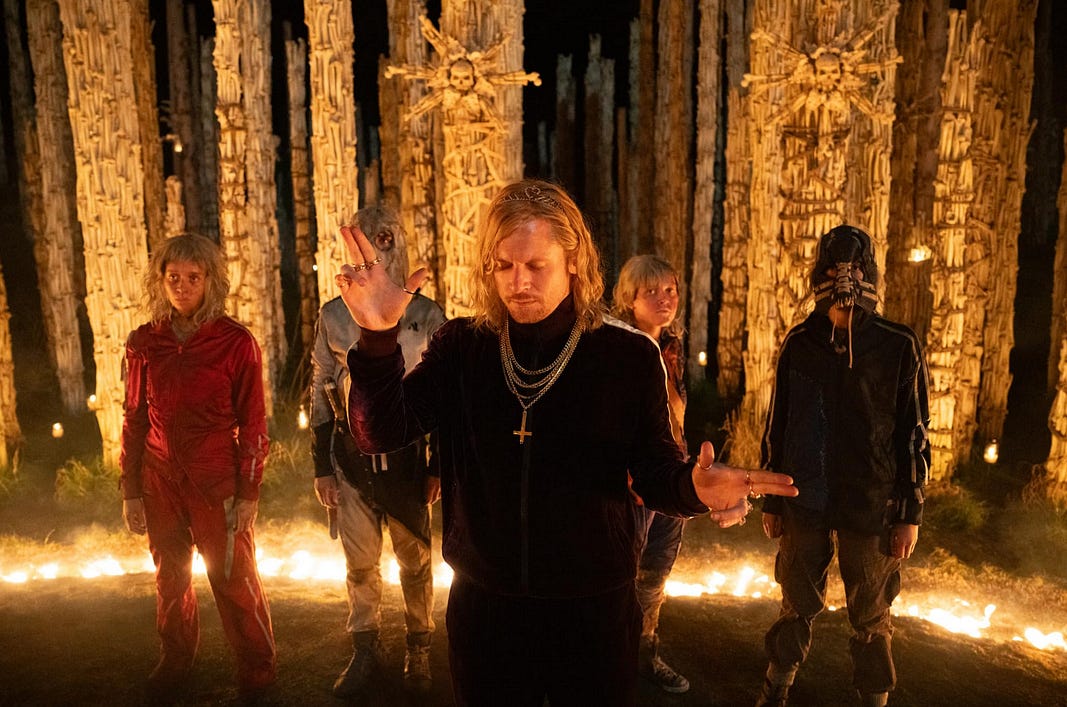
‘28 Years Later: The Bone Temple’ Bucks One of Hollywood’s Most Frustrating Trends
And reinforces a couple others
Most fans of cinema live in quiet acceptance of the fact that, no matter how many sequels a movie gets, it will almost invariably be a cheap imitation of the original. No matter how much of a masterpiece the initial release, or no matter how fertile of a bedrock it lays, few and far between are those followups that find ways to improve upon a saga’s beginning. From The Matrix to Jaws, The Exorcist, Jurassic Park, and The Blair Witch Project, it’s widely understood that those opening iterations set standards that are unlikely ever to be surpassed.
Yet in the world of video games, iterative improvement has always been the law of the land. Games grow bigger in size, provide more features, and grant more ways to navigate the virtual realms they traffic in. Developers take the foundations of those early entries and reliably build upon them. As a result, I’ve felt especially annoyed with the runaway movie franchises that operate under the assumption that refinement is impossible. The ones that do no more than relay a few cynical references to the original film, toss in some half-baked special effects, and call it a day. As much as I enjoy the relatively mindless entertainment of Marvel and Avatar movies, it’s hard for me to argue that they do enough to justify their existence on a narrative level.
In a visual media, spectacle for the sake of spectacle isn’t something I’ll simply dismiss. But rarely do such movies do better than to immerse me in their worlds for a couple hours. To truly strike me in my core is uncommon.
28 Years Later (2025) is a long-awaited followup to the 28 Days Later and 28 Weeks Later arc that began over two decades prior. And by nearly all accounts, it offers a more-than-worthy-if-slightly-loose continuation of that same story. It isn’t just another passionless, late-stage-Hollywood rehash. While I have a difficult time arguing that it surpasses the heights of its progenitor, if nothing else, it stands as a rare departure from the radical worsening trend that defines so many series that continue on past their prime. It’s propulsive, introspective, and colored by a cast of remarkably well-realized characters. And it serves as a rejuvenating breath of fresh air in a franchise that hadn’t inhaled oxygen since I was in elementary school.
28 Years Later: The Bone Temple (2026), by extension, is arguably the most inventive that this universe has ever felt. Following that prior film’s release by a refreshingly minimal six months, it begins chronologically where the previous one left off. Yet, despite the brief gap between where one movie ends and the other one starts, the opening scene establishes a significantly darker and gorier sensibility than its predecessor. Spearheaded by Nia DaCosta rather than Danny Boyle, differences in their directorial approach quickly abound. But Alex Garland’s script is an effective throughline between the disparate films. The variation in tone feels more meticulous than incidental. It ensures that whiplash never sets in as the rollercoaster ride continues.
For all of 28 Years Later: The Bone Temple’s successes, one fault I can’t help but find is in the prerequisite level of numbness that it demands of viewers. It’s yet another entry on the growing list of movies that asks audiences to sit through a stomach-churning deluge of maimings and decapitations if they’re going to derive any enjoyment from the overarching plot. It’s steeped in the understanding that, for a film to pull the same visceral reactions from audiences that Psycho once elicited (let alone enter into the same arena), it needs to indulge in such limb-shearing savagery that it can haunt even the most hardened of war veterans.
I can’t really call the assumption flawed. The problem I raise is with Hollywood and our culture at large. Still, I doubt I would have been so unblinkingly captivated by 28 Years Later: The Bone Temple if it were more restrained in its depictions of brutality.
Even as someone who grew up on Grand Theft Auto games, it’s a little frightening to me just how desensitized present-day audiences are expected to be. For consumers like my father, who came of age at a time when practical effects reigned supreme, many of the greatest stories of the modern age remain utterly walled off from him. While I’m sure there are elements of this recent film that he would love, I just can’t expect him to wade through the grating violence it would require in order to reach those more thought-provoking junctures.
One of my favorite aspects of the film, ironically, is one of the most reviled features of The Walking Dead. In the first seasons of the show, it’s the threat of the ambulatory corpses that override all others. But as seasons go by and zombies become more of a mosquito-like pestilence than an ongoing threat, the show centers more and more around the sprawling emptiness of that post-apocalyptic world. The threats posed by flesh-craving cadavers are gradually replaced by the peril of other people and their in-fighting factions.
28 Years Later: The Bone Temple is the first entry in the franchise to veer away from the infected as the plot’s driving force. Responsible for most of the screen time is the tension between people and their volatile hierarchy of power. And far more interesting than the cycles of finding shelter and fending off infected are the relationships between the denizens of this unforgiving world.
One of the components of this latest installment that impressed me most was the unsubtle presence of humor. When even three-hour-long blockbusters like Avatar: Fire and Ash can stretch on for such grueling lengths without so much as a lone dad joke or pun, it’s all the more impressive that a film so unremitting in its darkness can leave room for earnest outbursts of laughter. At face value, it may not sound possible or appropriate to incorporate humor into such a gritty, sobering saga. But just as Schindler’s List finds a place or two to make light of one of humanity’s darkest chapters, the forsaken world of 28 Years Later: The Bone Temple proves a surprising springboard for hilarity.
I’ve often felt like zombie movies and TV shows get a bad rap. It’s true that, in their most basic form, they’re little more than the same digestible archetypes of people evading monsters that have dominated entertainment and literature as long as we’ve told stories. But something that the best of these tales tap into is the philosophical weight of losing the world that was once taken for granted — that seemed too sturdy to collapse.
Among the most poignant illustrations of this comes from The Last of Us, when one of the characters — who’s never known anything apart from a society that’s already fallen to pieces — stares in disbelief at the remains of a crashed airplane laying in a nearby field. To her, the decaying monolith stands as proof of a civilization capable of miracles. But to her companion, it’s hardly awe-inspiring. As an adult who still harbors memories of middle seats and overpriced sandwiches, the site only conjures memories of a bygone inconvenience. It’s often in those gulfs of perspective between those who remember life before, and those who can only imagine it, where these stories achieve their greatest impact for me. They drive home the fragility of the modern world and invite us to revel in all of the futuristic luxuries that remain intact.
28 Years Later: The Bone Temple and its predecessor explore not just the intergenerational trauma that the infection has thrust upon the planet, but the diversity of ways that different age groups have been affected by it. In only the days and weeks after the virus broke out, such rippling consequences didn’t make narrative sense to examine. The disease was a democratizing force. But decades after that initial pandemonium, we’re given the opportunity to see its far-reaching effects.
We see how, depending on peoples’ age during the epidemic, they regard those halcyon days before the chaos through widely varied lenses. It isn’t just a story of desperation and survival so much as the long-term psychic residue left behind by a society that functioned, thrived, and then faltered irreparably.
As in The Last of Us, Garland’s characters move through the dilapidated aftermath of their world with a mixture of curiosity, superstition, and penitence for what was. They live among artifacts whose original purpose has been forgotten — landmarks that have rusted, decayed, or been entombed by vines.
The chasm between that evolved world of yore and its current inhabitants — who’ve regressed back to foraging for berries and hunting with bows and arrows — mirrors one character’s personal evolution. Some of the most soulful scenes center around a member of the infected and his returning memories of what it was to be human. They offer a palpable glimpse into the grief and confusion that overtakes people as infection forces them to abandon their identity and give in to the virus. Inversely, the scenes portray the wonder and enlightenment in reassuming their former incarnations.
The moments also strike obvious parallels to human evolution, and the intellectual vaults that were made between our cave-dwelling ancestors and our contemporaries that constructed skyscrapers, airplanes, and satellites. More specifically, it provides a direct allegory to “the stoned ape theory,” which suggests that psychoactive substances like “magic mushrooms” played an integral role in us growing to be the walking, talking, warring, computing, and creating people we are today. While unsupported by science, it hypothesizes that the shifts in thinking that specific drugs induce are what opened the door for modern humanity to flourish.
There’s a magnetism to these scenes that distinguishes them from the standard “character is tripping” tropes that have cropped up in an increasing number of movies as psychedelics have permeated pop culture. Rather than being used as a crutch to communicate humor or profundity, the drugs are presented here as a shaky ladder back to empathy, memory, and self. A bridge between our basest, most carnal impulses and the humble beginnings of reason.
28 Years Later: The Bone Temple is a lovably twisted reminder that the zombie genre has the potential to be about far more than fleeing necrotic predators and pillaging boarded up stores. At its best, these movies can be emotional, unexpected, and even meditative. They can serve as a poignant parallel to our present and urge us to reflect, not only on all of the inconceivable advancements we’ve already made, but all we have to lose.


By the way, I assume you're aware of the Jimmy Savile connection with this film. It is a little queasy for us Brits seeing Americans cosplay Sir Jimmy Crystal (in ignorance) given the Savile connection.
I left some comment vomit on the version of this article you posted on Medium, so I'll spare you here, except to reiterate this is characteristically well-written (as always). :)