
50 Years On, ‘Rocky’ Remains a Global Influence
Though not every scene has aged gracefully, Rocky Balboa stands as a timeless symbol of my city

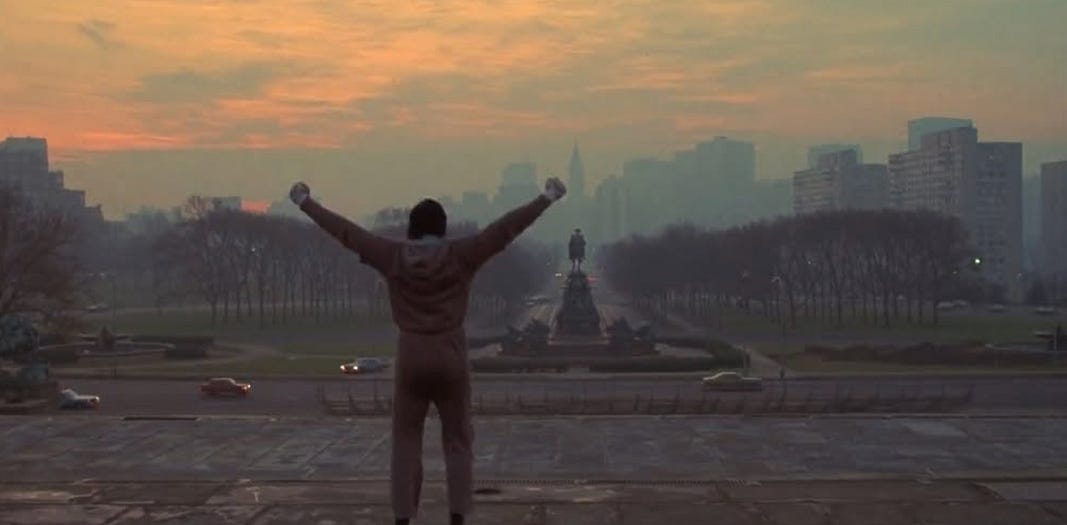
Despite being the “movie guy” in my friend group, many might be shocked to discover that I’ve still never seen Star Wars. Among the most criminal entries on the list of all-time greats I still had yet to watch, though, was Rocky. At least, until this week it was.
But just in time for the film’s 50th anniversary, and for America’s-250th-birthday-slash-celebratory-UFC-fight-on-the-lawn-of-the-White-House extravaganza, I’ve finally knocked that hallowed boxing movie off of my watch-before-I-die list. (Admittedly, America’s semiquincentennial played no role in the decision to finally confront Rocky, and I’m well aware that boxing and UFC are separate enterprises. But having finished the film, I’m now at least 6% more inclined to grant these modern gladiator duels a few minutes of free viewing.)
Much of the shame over my failure to watch Rocky until now owes to the fact that I’m a native Philadelphian, and there’s likely no movie that’s ever served as a greater source of honor for our city. Each time I pass the art museum, night or day, rain or shine, there are tourists from around the world lined up to take their turn running up its illustrious steps — or, at the very least, snap a picture with the Rocky statue fixed atop it.
Traveling abroad, there’s no guarantee that people will be familiar with the state of Pennsylvania when they ask me where I’m from. Nor is our state capitol likely to trigger any immediate name recognition. Yet, when I say I grew up in Philadelphia, it generally elicits one of four specific reactions: they reference the Eagles and our recent Super Bowl win(s), The Fresh Prince of Bel-Air, or our unchallengeable reign over the cheesesteak domain. But likely the most common reaction of all is to simply name-drop Rocky Balboa.
“Ahh Philadelphia! Like Rocky!” I’ve heard echoed a hundred different times in a hundred different accents. The enthusiastic mentions have grown into a hilarious staple from my time abroad. More than even the Liberty Bell, it’s that venerated boxing mascot who has become the enduring emblem of Philadelphia pride.
At face value, I wouldn’t think that Rocky would hold the broad appeal that it does. While the cultural popularity of baseball and football explains the success of films like Field of Dreams, The Sandlot, Remember the Titans, and The Blind Side, the allure of boxing has always seemed more circumstantial.
When typical sports seasons would kick into gear, people would wear their jerseys to school, proudly parading their fandom on their sleeves. But it would only be in the immediate days leading up to a fight between Floyd Mayweather and Manny Pacquiao, or whatever other fighters happened to be headlining, that I’d be reminded of the sport’s persevering intrigue. Fans I never knew existed would rapidly emerge from the woodwork. Chatter about where they’d each be watching the pay-per-view event would overtake the halls.
I didn’t realize it then, but I think much of my district’s enthusiasm owed directly to Rocky. In another city, these sporadic KO contests likely wouldn’t have become such a draw for my peers. But in Philadelphia, we learned to take a rare level of pride in these gruesome feats of human endurance.
Before watching Rocky, I hardly ever stopped to ask myself what made these harrowing fights so enticing. Though boxing often seems sidelined when compared to the MLB or NFL, IMDb lists Rocky as the single greatest sports movie of all time, above even films built around those more traditionally well-liked sports. It’s no wonder that the movie transcends borders and warrants shoutouts every other time I mention where I’m from. Director John G. Avildsen is uniquely effective at bringing the sport to life and humanizing his characters. He establishes a sense of stakes that feels palpable even for viewers who’ve never watched a boxing match in their lives.
I didn’t expect to be captivated by Rocky’s training, or to be so enamored with Syllvester Stallone’s portrayal of him. He’s simple and inarticulate, but still retains wit and a world-weary sense of charm.
As Rocky traded blows with his opponent, I didn’t expect to be so invested in the fight’s outcome. It was hard to watch yet hard to turn away from. Boxing feels simultaneously at odds with civilized society, and one of the most scabrously pure forms of sport that we have. There’s something elemental about a competitor achieving victory on such raw and animalistic terms.
In the same way that football has taken hold of the American psyche for the tectonic clashes between teams of 300-pound men, there’s a primal sort of magnetism to the notion of two trained fighters pushing themselves to the absolute brink of what their bodies can withstand.
It’s fascinating how universal of an icon Rocky has become, not just across borders, but across generations. As a self-proclaimed modernist, much of my resistance to the movie was simply its pre-1980 release date. After all, my lone attempt to watch Star Wars (1977) was cut short at the hands of my tragically limited tastes.
“Dad, this looks old and stupid,” a ten-year-old me lamented as my kindly father fruitlessly coaxed me to continue.
But as an older, maturer man now, I’m proud to say that I’m modestly more open-minded toward the movies of yore. And Rocky went over far more smoothly than I feared. (Some day soon, I’ll grant Star Wars a proper revisit.)
The only real reminder that I was stepping into another era when starting Rocky wasn’t the pacing or the film grain, but that the culture on display was nearly beyond recognition.
Not only is that 1970s version of Philadelphia almost completely different from the one I’ve known throughout my life — with different customs, skyline, and demographics — but the dynamic between men and women was also completely different.
In one scene, Rocky implores his reluctant date to come into his apartment, and when she tries to leave, he blocks the door. He then invites her to begin undressing. In the scene, it’s framed as typical, gentlemanly behavior, even bordering on something chivalrous. It’s hard to believe it was so recently that Rocky’s sexual advances toward his love interest were received by audiences as so innocuous.
Today, in a world where explicit consent has grown to mean so much, the protagonist’s actions would often be likened to rape. They feel especially discordant coming from this character we so often lionize for his bravery and nobility.
Yet, it might be a disservice to judge directors of the past by the standards of today, and if we always fell into that trap, we’d be deprived of some of the greatest stories ever made into movies. That such social conventions feel so antiquated today, more than anything else, stands as a fascinating case study of just how much culture can change and progress in half of a century. Perhaps Rocky’s greatest achievement is that it’s continued to remain such a relevant part of culture even as the world in which it was released has evolved beyond recognition.
The script and the acting of Stallone both had me from the beginning of the movie, which I saw in the theater in the Bay Area in 1976. I also loved Carl Weathers in the movie. Of course, I saw the first four movies and for Weathers, Predator with Schwartzenegger. When it comes to these type of movies, there are no better. You should watch Ali's When We Were Kings. It is also great. Boxing movies are not all bad.
Your usual thoughtful writing here. I loved ëverything about Rocky, even the love scene that made me cringe. People got into it because of the music, which makes your heart soar, the triumph of connection and hard work to beat his bigger and better opponent, and the love story.
I have spent time in Philly and my husband and I both did the steps.....
DADA DAAH, DADA DAAH...