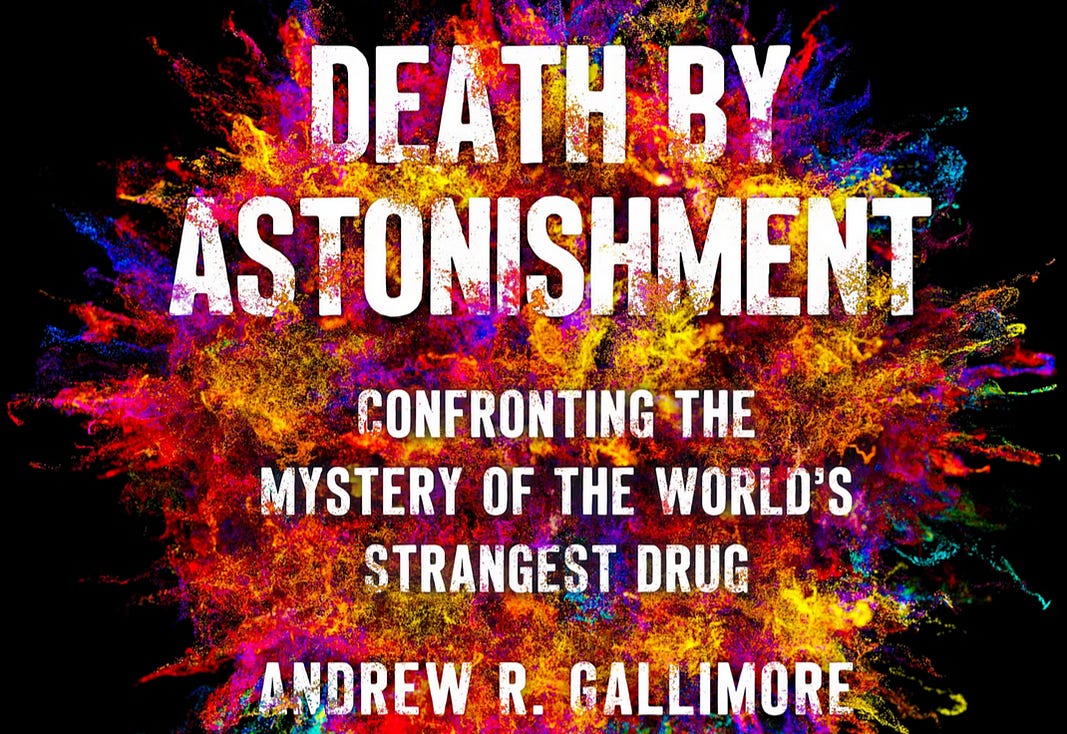
‘Death by Astonishment’ Tackles the Ineffable and Falls Forgivably Short
Andrew Gallimore’s most ambitious work to date can’t quite achieve all of its aims, but deserves praise for the attempt
There’s a passage in the foreword of Death by Astonishment that frames the book and the lofty mission behind it beautifully. It’s at once admirably brazen and honest to a fault. How it reads for you will likely dictate the value you’re able to derive from author Andrew Gallimore’s research.
When scientists come up with bold ideas and make even bolder proposals on the basis of them, they’re well-advised to do their groundwork extremely thoroughly first.
In the case of neuroscientist Andrew Gallimore, the bold idea is that for countless millennia our species has participated, largely unwittingly, in a dance of interaction with a vast alien intelligence — an intelligence not only not of this earth, but also not of this solar system, not of this galaxy, and perhaps not even of this universe. An intelligence completely other from otherwhere and otherwhen.
Gallimore’s even bolder proposal is that the most efficient means to explore, investigate, strengthen our interactions with, and ultimately understand that alien intelligence is through ingesting, by various routes, a simple molecule, widely available in nature, known to science as dimethyltryptamine-DMT for short!
It sounds crazy, doesn’t it? But as you read Gallimore’s masterful Death by Astonishment, you’ll discover that he has indeed done his groundwork extremely thoroughly. And this is as it should be because his big idea and the proposal arising from it have the potential to turn what science believes to be true about the nature of consciousness and the nature of reality itself upside down and inside out.
What I love about Graham Hancock’s opening is that it makes no effort at all to walk around or conceal the bizarreness or grandiosity of the book’s central hypothesis. Yet what gives me pause is that it also immediately runs the risk of alienating the very audience it most intends to persuade.
For someone who’s actually taken DMT and shared in the experiences that the author goes to such copious lengths to detail, that woo-woo introduction comes across as shockingly reasonable. But for readers who haven’t, red flags begin cropping up before the author can even clarify that cynicism is natural. When confronted with the outlandish claim that Gallimore attempts to support, knee-jerk denialism isn’t only to be expected, but may be the only rational response.
And yet, what the drug offers is so far removed from the scientific model, from the bounds of our rational thinking, that it reliably shakes users to their core. More often than not, it changes their perception of time, the universe, and opens their eyes to all of the enigmatic creatures and entities it might contain. Even those who approach the drug with deep-rooted skepticism are quickly slapped in the face by the utter incomprehensibility of what they witness upon ingestion. Worldviews collapse in an instant as users are catapulted into a circus of scintillating oddity that our vocabularies lack the ability to relay beyond its most trivial details. We encounter shapes and objects that not only don’t exist, but can’t exist— at least not within the reality we know.
Gallimore argues that, in the throes of a DMT experience, people commune with discarnate, otherworldly intelligences and report such a profound degree of common ground between their “trips” that it lends an uncanny degree of credibility to the accounts. There’s a commonality not only between who and what people witness when they take the substance today, but to what indigenous tribes of the Amazon have encountered on it throughout the thousands and thousands of years it’s been used.
When I picked up Death by Astonishment, there were a couple of objectives I hoped it would fulfill. First and foremost, I hoped that it would lend clarity to these ineffable experiences that I’ve had myself. I hoped it would grant a more scientific lens through which to interpret them. On some counts, the book succeeds. Gallimore has a deep chemical knowledge of how DMT interacts with the brains of mammals and the convoluted history of how it came to be used as it is today. He methodically takes apart the explanations science has offered for why DMT elicits precisely the experiences that it does. One by one, he illustrates how each hypothesis comes up short of accounting for the impossibility and profundity of the odysseys that the substance occasions.
The approach taken reminded me of another book I read when I was younger called Proof of Heaven. Written by Dr. Eben Alexander, it details the account of a hard-minded neurologist who, when in a coma, has a series of experiences that irreversibly shatters his perceptions of life and death. Similarly to Gallimore, he enumerates each of the ways that his brain could have potentially given rise to all of the strange phenomena that he was thrust into during the time when his body was inactive. And with a near-identical methodology, he discredits each of the explanations that science would conventionally provide for the perplexing, internal trial that he endured.
As Alexander walked me through how he began to believe in god, I felt myself undergoing the same transition. The book provided my first glimpse into a world outside the confines of what science can explain. But as months went by, the cogent argument that Alexander put forth lost its grip on the brooding, Richard Dawkins-devouring atheist that I was. I ultimately likened the neurologist’s stance to the “God of the gaps” argument. (It can essentially be summed up like this: god resides within the gaps that science has yet to explain. “Science can’t account for this mystery, therefore it must be God!” But as science explains more, god’s role in the universe appears smaller and smaller.)
So I eventually dismissed Alexander’s conclusion. I reasoned that, just because science couldn’t explain his experiences didn’t mean it never would, and it certainly didn’t mean that a divine explanation was where Occam’s Razor pointed.
Until I first tried DMT for myself, I believed more or less that the world I could see was all that there was. That if it sat outside of science’s reach, it was more than likely fiction. Claims of gods and transdimensional deities should be reserved for fables and sci-fi, I smugly concluded.
The adolescent that grew up on the New Atheism movement is still alive in me somewhere. But I have an impossible time reconciling that dormant mindset with the adult me who’s now experienced what he has. The two are at clashing, cackling odds with one another.
As a result, one of the other objectives I hoped Death by Astonishment would achieve was appeasing the vestigial cynic inside me. I hoped that the book would be a bit more compelling for the part of me that still sees a sprawling gap between where our science falls short of explaining the DMT experience and the explanation that, “therefore, it’s caused by aliens or discarnate entities.”
For my open-minded half — the one that now helms this ship of flesh and cells — the author’s explanation is the only one that can even begin to make sense of the DMT experience’s radical abstrusity. Unlike in the weeks after reading Proof of Heaven, I couldn’t simply dismiss the trials detailed in Death by Astonishment. I’d undergone them myself and found a hair-raising catharsis in all of the trip reports Gallimore compiled that were so remarkably comparable to my own.
I also attempted to read the book through the eyes of the many peers and fellow cynics for whom I’ve been woefully unable to convey the worth of my experiences. One of the biggest pitfalls of the book is one of the most relatable. I’m all too familiar with DMT and the Herculean task of attempting to put its offerings into words.
Very often, the drug inspires something almost akin to “missionary work,” where those who’ve used it can’t help but proselytize and persuade others to explore the avenue themselves. It’s a kind of zeal I’ve struggled to resist in my own writings on the topic. I relate to the frustration that Gallimore continually references; the only dependable way to dissolve people’s doubt about the drug is to convince them to do something they’re bullheadedly unwilling to. Taking DMT is simply too intrepid.
In making the case that Gallimore does, I can’t help but detect an air of that same “You can’t know Christ’s love until you’ve felt it for yourself!” mentality that I’ve always felt so reprehensible in the world’s monotheisms. It frustrates me that in the case of DMT, so much of my own argument for its value still rests on something so similar. Each time I explain what I’ve experienced, I almost invariably return to the notion that it needs to be seen and felt to be understood, and no earthbound explanation can adequately impart its meaning.
There’s a relatably unjournalistic enthusiasm to Gallimore’s tone that pokes through at times, and it detracts from the credibility he cultivates in his more grounded, scientific passages. He shies away from much of the wide-eyed mysticism that soured many to the psychedelic preachings of Timothy Leery and Terrance McKenna. Yet it still fails to strike the measured restraint and poise of Michael Pollan’s How to Change Your Mind, one of the other most obvious points of comparison to Death by Astonishment.
Pollan, living most of his life and firmly establishing his career as an author before ever exploring the world of psychedelics, eschews many of the stereotypes for which those early psychonauts like Leery were so infamous. His authority doesn’t come from evangelism or personal revelation as much as his unabating diplomacy. In How to Change Your Mind, he positions himself not as a convert or prophet, but as a curious, aging skeptic who insists on placing his own experiences behind layers of reporting, historical context, and scientific consensus. Where Gallimore occasionally allows wonder to spill over into exuberance, Pollan is almost allergic to overstatement. He’s meticulous about separating what was felt from what can be fairly claimed, and what was meaningful from what can be empirically proven.
That distance is much of what lends Pollan’s work credibility, especially for readers who open the book harboring negative preconceptions about psychedelics. He doesn’t ask them to take a leap of faith.
In contrast, Gallimore’s hypothesis — no matter how rigorously argued — requires a willingness to entertain conclusions that science itself hasn’t yet equipped us to verify. Where Pollan invites curiosity, Gallimore courts astonishment.
I don’t think that Death by Astonishment is the book that will convince readers to seek out DMT or any comparable psychedelics if they weren’t previously inclined to do so. But for a reader who’s already made that leap, it’s thrilling to watch Gallimore trace the contours around what’s likely the single most confounding mystery I’ve ever confronted.
No matter how much hard science, chemistry, or history the book contains, Gallimore still doesn’t take us much closer to understanding why this substance — that’s found in everything from plants and trees to our very own biology — induces interdimensional odysseys that turn preconceptions of the universe and the laws that govern it on their heads. But I have to commend Gallimore for his attempt to humanize, destigmatize, and clarify an experience that’s so fundamentally beyond words. Even if we’re still years or decades beyond science’s ability to adequately explain DMT or its role here on earth, I’m thankful that more and more scientists are beginning to grant this mystery the attention it deserves. I’m thankful that writers as well-researched and articulate as Gallimore are grappling with this enchanting enigma, and that enough people are finally willing to entertain his abstractions for Death by Astonishment to enter the mainstream.


