
‘Disclosure Day’ Is Overly Ambitious But Highly Commendable
Despite its pitfalls, Steven Spielberg’s latest alien saga offers much to enjoy

It’s a recurrent theme for me while writing that I’ll begin to feel the piece I’m working on tug in multiple directions. New ideas surface, and as I explore them, sometimes one paragraph evolves into three. Pretty soon, I’m working with a tangent that’s far too unwieldy to be housed within the same article as my central thesis. Other times, it’s important for me to commit to my detour for just long enough to demonstrate how two seemingly disparate ideas connect.
Now, before I get to how any of this ties in to Steven Spielberg’s new summer blockbuster, I’ll ask you to bear with me as I ferret into this rabbit hole just a few feet deeper.
In recently putting together an article on the movie Backrooms, I began to feel as though my draft had mutated away from its original intent and become a broader exploration of liminal spaces and The Shining. There was a personal connection that I’d initially wanted to explore as well, but as it had already begun to suffer from a bit of bloating, I decided that the memoir component of the story would function best with enough room to breathe and as its own piece.
By contrast, there’s a philosophical diatribe that I’ve now spent over a week constructing. It’s about the oddity of life on earth throughout the advent of AI, and moreover, about the relationship that we have with progress. Pieces like this are simultaneously among the most challenging and fulfilling to write. Because they’re so grand in scope, they feel like the very most important work that I have to offer as a writer. But in their sky-high aims, I think that they run the risk of failing most miserably. Because the ideas I’m trying to tackle are so enormous, it’s easy to fall short in my efforts to do them justice.
Before this train of thought careens past its main destination and becomes yet another piece of its own, I’ll get to Spielberg.
The reason for my lengthy opening anecdote is that I can’t help but see the same struggle at play in Disclosure Day. And because I’m sympathetic to what a balancing act it can be for creators to pursue our loftiest ideas through to completion, I’m reluctant to speak too negatively about the film’s shortcomings. What Spielberg attempts to create here is even more colossal in its scale than Close Encounters of the Third Kind and Schindler’s List. He tries to capture humanity from arguably the very broadest lens that he has yet, and deserves real commendation for the effort. (Close Encounters depicts a similarly momentous crossroads for our species, but deals more with the personal side of the event instead of its far-reaching implications.)
As per Disclosure Day’s title, it’s a story about the day that humankind learns that we’re not alone in the universe. It’s such an enormous event to convey that it would have been difficult for any director to do it justice. And I think Spielberg is the rare auteur who may have been up to the challenge. In moments, he drives home the gravity of the day so beautifully that I can’t help but recommend the movie.
But where I think Spielberg went astray was introducing enough of a sci-fi/fantasy element to the movie that it obscured the grounded, human side of his story. In attempting to say too much, he muffles the potency of his vision.
The congestion creates a kind of tonal dissonance. On one hand, among Disclosure Day’s greatest strengths is its presentation of humanity as we discover we’re not alone. There’s a spellbinding realism to the globalized revelation that aliens exist. It’s at once intimate and epochal.
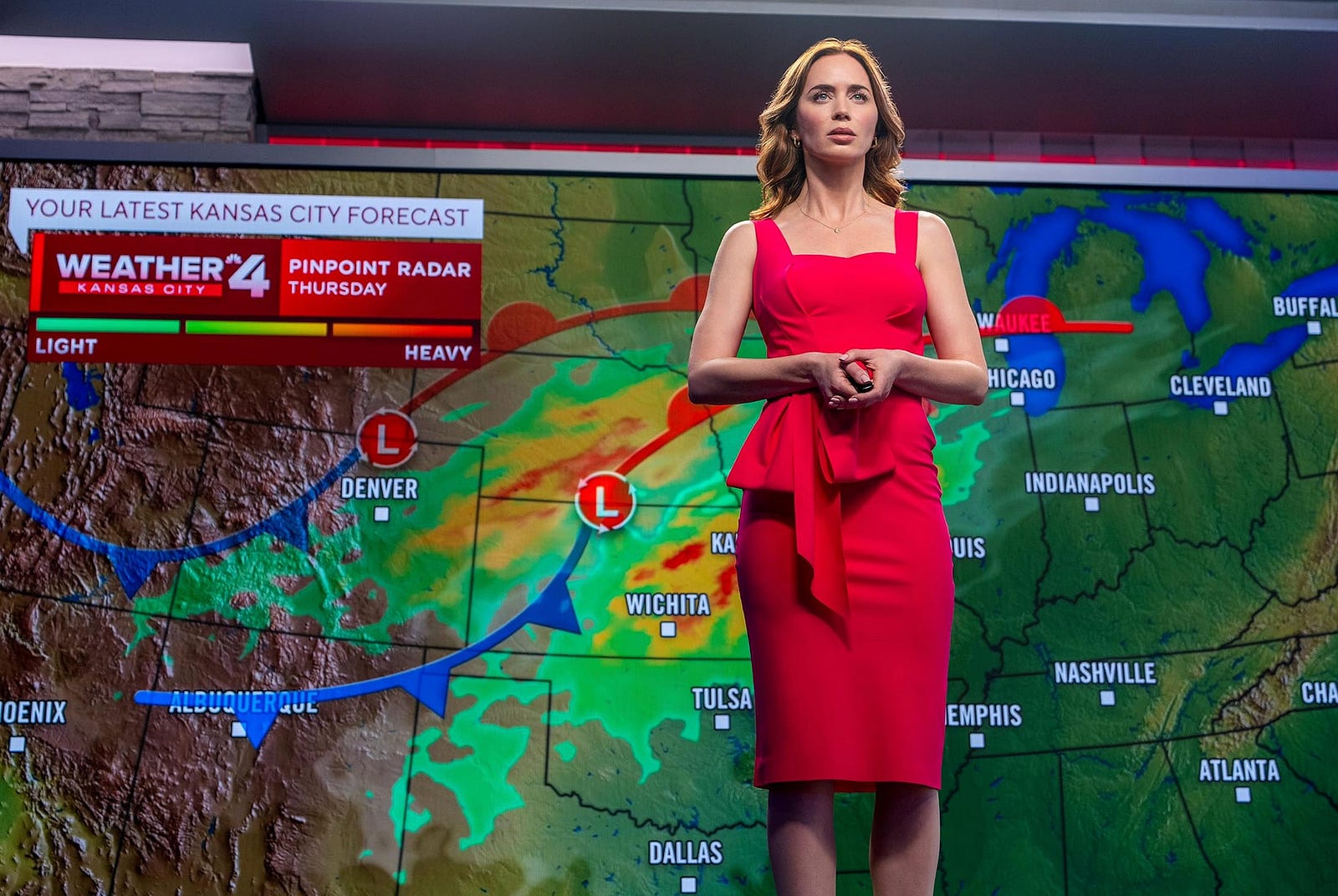
Even as we see footage flood TV screens across the globe of tiny men being pulled from crash sites and prodded, Spielberg effectively sells the illusion that we’re sharing in that monumental, species-wide experience. As we see reporters react live to the news, the mixture of awe, fear, and existential bewilderment on their faces drives home the history-defining moment. (Courtney Grace, in particular, viscerally captures that range of emotions.)
And yet, Spielberg spends a healthy amount of the movie’s runtime effectively undermining the poignancy that such scenes can impart. At times, Disclosure Day leans into the sci-fi enough that it borders on hokey and generic.
Despite our awakening to aliens’ existence being central to the movie, there’s very little about their disclosure itself that calls for anything supernatural. I think the movie would have been most effective if it were simply about our humanity as we approached this seismic new chapter. Ethereal forces didn’t need to be called into action. If it had just been a film about two factions—the protagonists trying to disseminate the information to the public and the nefarious agencies trying to keep it a secret—it would be both more digestible and more poignant. It works far better as a conspiracy thriller than as a metaphysical wonder tale.
I think Disclosure Day’s two halves could have been effectively fleshed out into their own separate movies. But as one project, it can feel disjointed enough to induce mild whiplash in its worst moments. I suspect that there was a draft of this movie (apparently, it went through over 40 iterations) that tied the elements together a bit more cohesively. But it’s hard for me to imagine that version running much shy of 4 hours.
Had Spielberg turned Disclosure Day into a mini-series, I think such a canvas would have been better suited for the high-reaching visions he had for this story. Inversely, if he’d cut out all but what made the movie most emotionally resonant, I think its credits could have rolled in time for the 90-minute marker. But in committing to both sides of this story and a 2-and-a-half-hour runtime, it comes across as both bloated and rushed.
Yet for all of its weaknesses, Disclosure Day gave me plenty to enjoy. The acting is strong, the cinematography is engrossing, the scenery is well-chosen, and the action sequences are nail-biting. It’s also nice to have John Williams return to do the score, though I doubt many will find this one reaches the heights of the melodies that feathered the Jurassic Park, Harry Potter, and Star Wars franchises. (Or maybe I’m just bitter that this article convinced me to stick around after the movie for “something awe-inspiring,” only to discover it was referring, not to an earth-shattering post-credit scene or some sort of cosmic epilogue, but merely a tepid John Williams tune accompanying the credits.)
One of my favorite aspects of the movie is how it pairs with one of my all-time favorites, Don’t Look Up. In Don’t Look Up, in the face of the revelation that Earth will be destroyed by an asteroid, people go on more or less as we always have. It’s a just-exaggerated-enough allegory to humanity’s climate change response that’s hilarious in its scathing accuracy. Where so many disaster movies make the mistake of depicting a species that rises to the challenge of the threats at hand, Don’t Look Up portrays a cavalier sort of indifference that makes for worse storytelling, but also a more accurate portrait of humanity.
In Disclosure Day, the globalized announcement that aliens are real is met with an uncharacteristically unified response that, while beautiful to watch unfold, feels less true to the species I know. I’d like to believe that Spielberg’s portrayal of humankind broaching this new chapter is accurate. As a child, I had similarly idealistic views of what such a day could look like. And there’s a magic in seeing those childhood fantasies realized.
But events of recent years have convinced me that if such a societal rupture were really to occur, if our species were to collectively accept once and for all that aliens are real, it wouldn’t be much harder for us to adapt to than it was when cell phones or smart homes were first introduced.
Recent years have lent more and more credibility to the notion that aliens are real. Yet the mounting footage and testimonies from ex-government officials have done very little to usher in the watershed moment that Disclosure Day presents.
I no longer believe proof will ever accumulate to a point where newscasters of the world will come together to report that aliens are real, no matter how copious or incontrovertible the evidence. Should there come a time when we each accept that extraterrestrial life is real, I think the onset of that understanding will be so gradual that our day-to-day routines never halt for even a moment. It won’t be the grand event that separates all of history into a stark before and after. Far more likely, it will be just yet another oddity we adapt to.
I’ve even heard it theorized that evidence of aliens has been purposefully slow-walked in order to prevent the mass-scale destabilization that Spielberg suggests at. After all, if our belief in extraterrestrial life comes on gradually rather than in one fell swoop, it won’t be so disruptive for the powers that be.
Walking out of the theater, I found myself grateful for Spielberg’s bright-eyed telling of events. And I was thankful that, even in falling short of its earth-shattering ambitions, his story still managed to inspire viewers to congregate outside of the theater in feverish discussion after it had ended. And moreover, I was thankful for a cinematic experience that performed one of the most central functions that movies can: to make me think more critically about the world in which I’m living.