
Drones, Planes, and the Democratization of Awe
What modern technology can teach us about our smallness

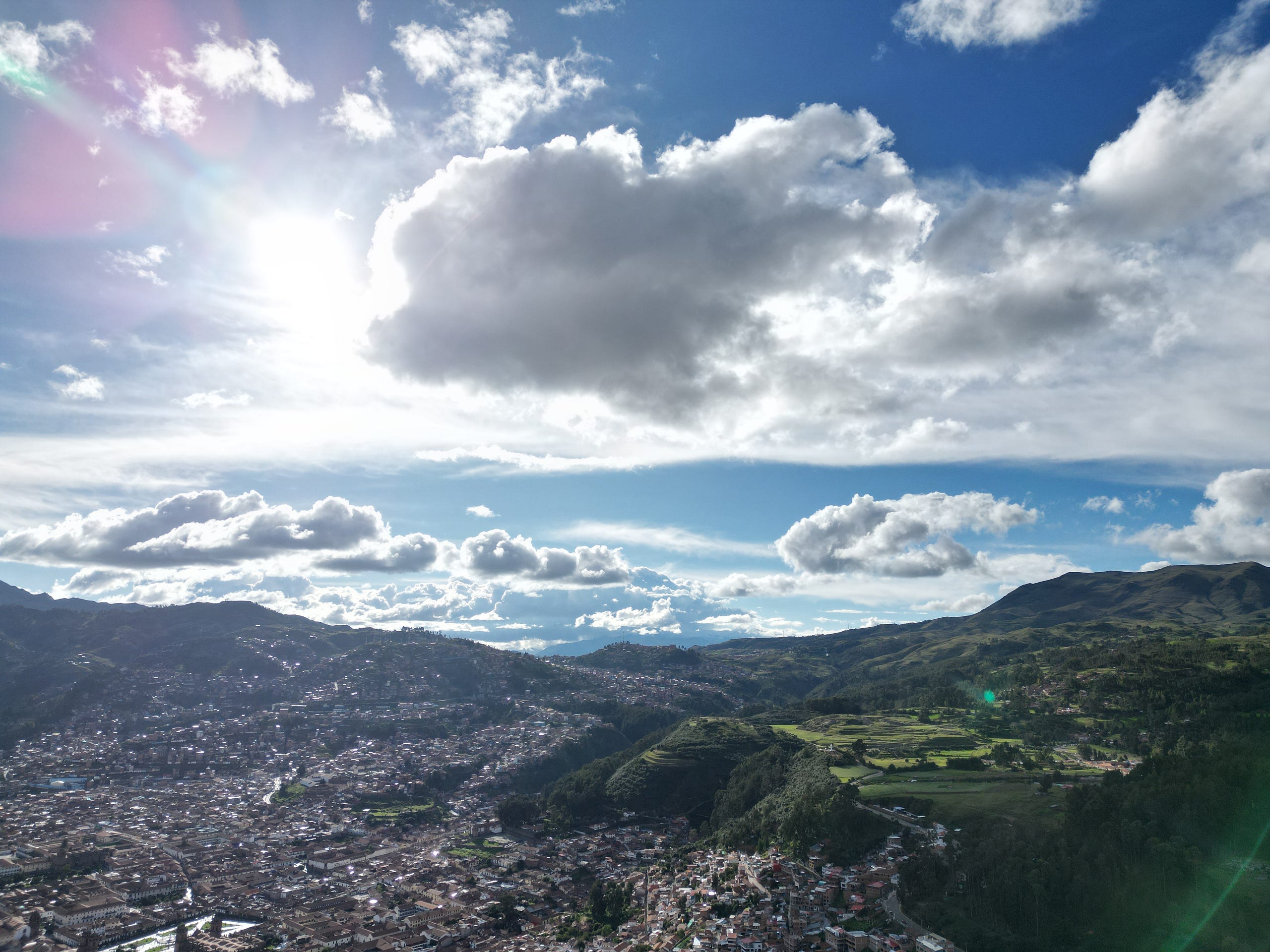
It was nearly three years ago that I found the opportunity to fly a drone for the first time. My friend Colin brought one to a graduation party, and as he tended to the airborne camera with his measured finger motions, I stood in shock at the talent it must demand in order to fly such a contraption. He was deft and delicate as he guided the futuristic device through the suburban skies. The sunset approached and his mid-flight camera twisted and gyrated in order to properly capture it.
Colin gracefully angled the camera’s lens toward the setting sun, up toward clouds, down toward trees, and over the roofs of a thousand unwitting denizens. They were none the wiser as to the aerial acrobatics my friend was performing over their houses, sweeping every which way and panning cinematically from side to side.
As I looked toward the monitor controlling it in lock-eyed fascination, he offered me the reins. “Ar — are you sure?” I stammered. Whether or not he trusted me, I didn’t trust myself. I didn’t think I had half of the skill and dexterity that it surely must require to guide such a modern marvel through the atmosphere. It wasn’t quite the same responsibility as piloting an airplane, but I figured it could only be marginally less complicated.
My lack of confidence wasn’t enough to dissuade Colin. He happily handed me the controller and I tentatively leapt at the opportunity. To my surprise, the few seconds it took to trade hands wasn’t enough to send his camera hurtling from the sky or crippling any unsuspecting birds in the process. More shocking still, in my few minutes fretfully tending to the control sticks, it remained reassuringly airborne. It was surprisingly user friendly. I moved it from side to side, up and down, forward and backward. Once I finally relieved myself of my duty and allowed him to helm the ship once more, Colin nonchalantly cradled the controller in his hands and pressed a mysterious “H” button that stood fixed at the controller’s upper center.
“Return to home,” the tablet shot back in an automated voice that sat firmly in the middle ground between Alexa and Siri. And with that thoughtless click, the mechanical humming bird began its methodical descent. It honed in on the location from which it launched with machinist precision and lowered itself to earth without a hitch. As if to brag, Colin hardly even watched as the process unfolded, maintaining conversation with fellow partygoers as the thousand-dollar device descended.
Blades of grass blew to the side as the pocket-sized helicopter landed, instilling certain terror in every insect within earshot. Colin picked up the now-motionless device, pressed the off button, and tucked it inside a little black case that had hung discreetly from his shoulder.
“I need to get myself one of those things…,” I said to myself.
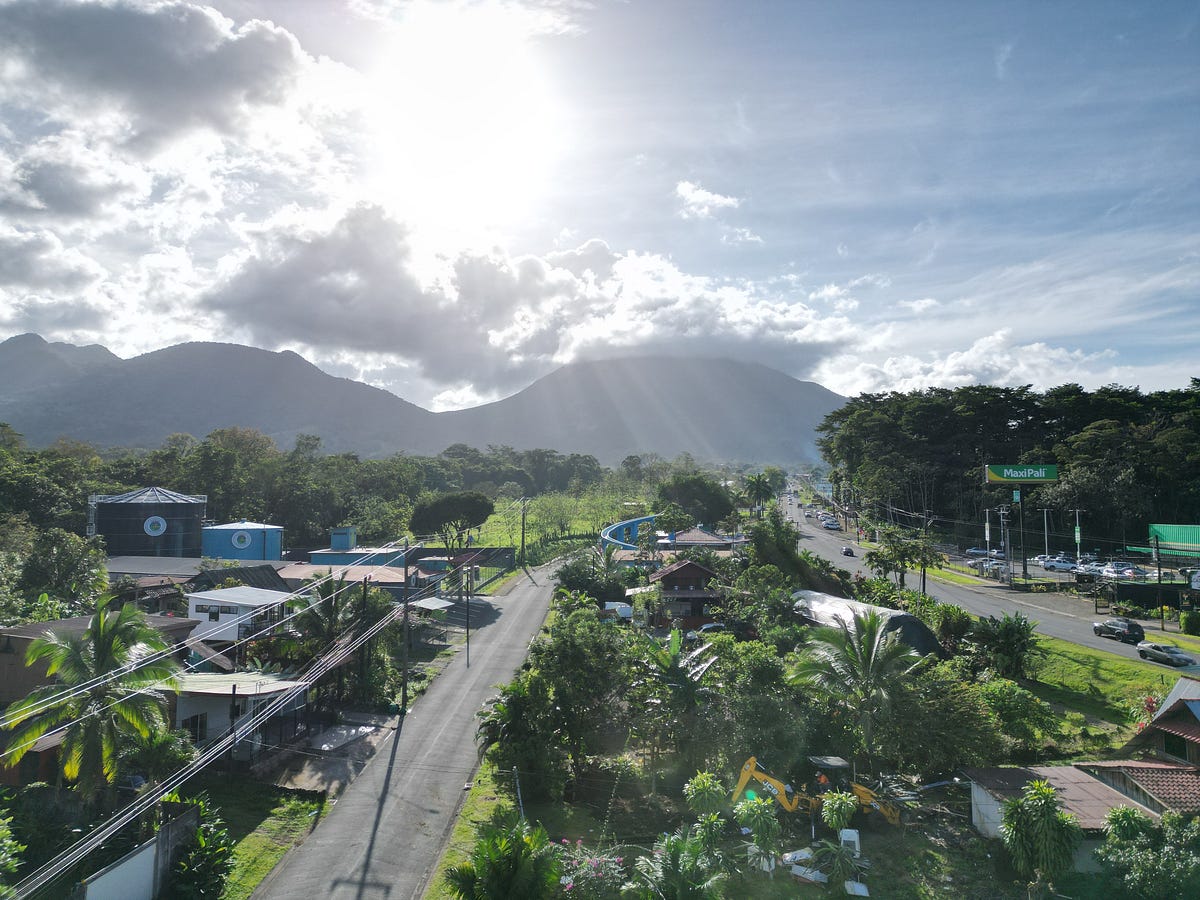
And a couple of paychecks later, I had finalized my purchase. My winged new toy was on its way to my house, and soon, I, too, could fly it over the heads of oblivious suburbanites. Over houses, above the antennae of my city’s tallest skyscrapers, over the desiccated sands bordering Las Vegas and the tropical beaches of Puerto Viejo. Toward the towering Volcano that framed La Fortuna and through the verdant mountains of Monteverde.
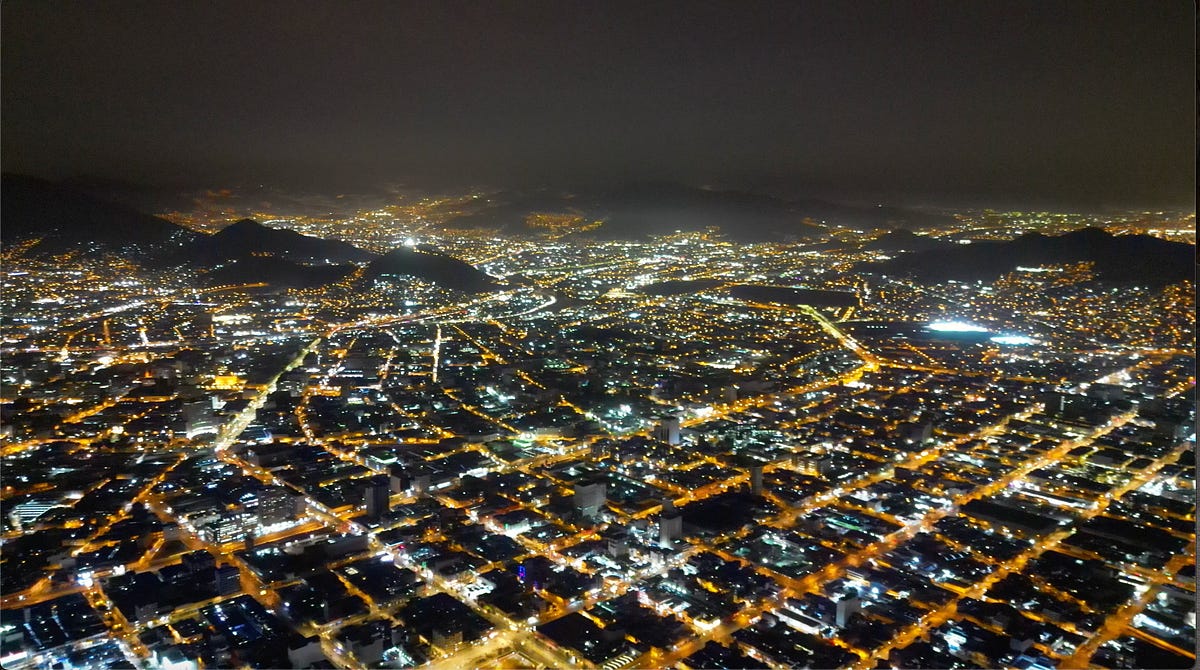
I brought the drone from Costa Rica back to my hometown in Pennsylvania, and from Pennsylvania all the way to Peru. I launched it into the Lima skies from the roof of my hostel, and watched the city shrink with a certainty that was as awe-inspiring as it was dispassionate. There’s a strange dichotomy in seeing our world pared down to its rawest rhythms. It’s at once majestic and indifferent. Humbling and empowering.
The people on the streets were rapidly reduced to tiny heads, each engaged in their separate routines. Their frenetic motions began to soften and the sum of separate parts started to form patterns. As with the law of averages, correlations only become clear once we zoom out. A sample size of a million will always show more than we can process from the hundred nearest passersby.
Ramshackle homes melded with skyscrapers, and cars shrunk into whirring beams of light, each weaving their way through the most gaping metropolis I’d ever seen in person. A little higher, mountains entered into view and the sprawling city grew more and more minuscule. The towering vistas dwarfed the city’s largest buildings and gave context to humanity’s fundamental smallness.
I hovered the drone above the wind-battered shores of Paracas and directed it two entire kilometers into the distance, the furthest I’d pushed the device to date. (In perfect conditions and without obstacles interfering with its line of sight, the flying camera has a range of up to 10 kilometers, even if I’ll likely never be brave enough to broach that upper limit.)
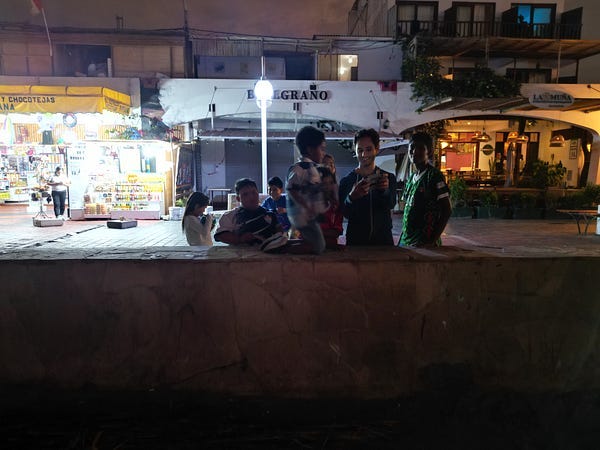
A few of the town’s children gathered around my controller after watching the tiny aircraft take flight. They ooh’d and ahh’d and asked questions that, even with their age-12-and-under vocabularies, I was woefully unequipped to answer without the assistance of a translation app. But there was a delight in being able to witness their spellbound gaze at the sight of their shrinking town, and to share in it.
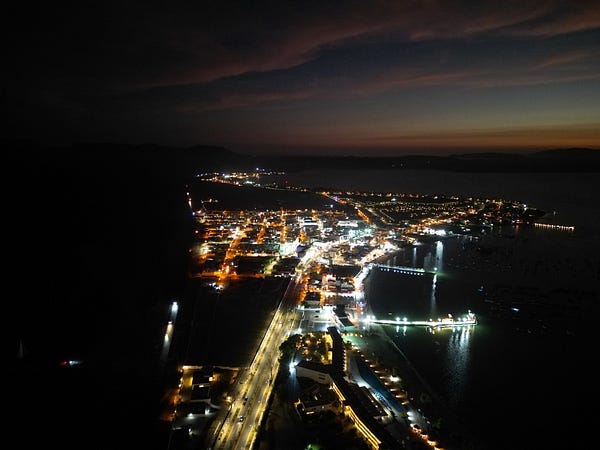
We watched together as the slow-moving, seaside bureau — and its roughly hundred ceviche vendors — were reduced by expansive desert and endless ocean.
There’s a strange guilt in being that foreigner who wanders into town with a First World arsenal of luxuries. I’m displaying a kind of wealth that’s uncommon in many parts of the world. But I never use my drone in order to flaunt.
To some United States citizens, a drone is scarcely more exorbitant than a designer purse, yet infinitely more useful. It’s orders of magnitude less profligate than a sports car purchase. At roughly the cost of a smartphone, the asking price is something that citizens of the States will hardly bat an eye at. It’s no wonder why they’re becoming increasingly common. In a decade, they may no longer elicit wonder for much of the world at all.
But still, to play with such toys today shoves in people’s faces a kind of technology that many have simply never encountered — especially in Third World countries. On a few occasions, children and adults alike have expressed bafflement at the notion that such a machine even exists. (Admittedly, my first experience with a drone was hardly different. That these devices had come so far was news to me — and that they could be next-day-delivered through Amazon was a more earth-shattering revelation still.)
At the same time that there’s a discomfort in demonstrating all that drones can offer, there’s something beautiful in sharing in the humility that our shrinking civilization can impart. For years, I’ve been as confused as I am frustrated with the masses of people who file into airplanes before proceeding to shut their windows, close their eyes, or resign themselves to a rewatch of Meet the Fockers. Under different circumstances, the novelty of looking down at the earth from such staggering heights could never be diminished.
People pay colossal sums to reach mountain peaks and eat meals with panoramic views of their surroundings. But because air travel has become standard to much of the world, so often it’s treated as a banality, if not an outright inconvenience. People set aside the wonder in watching the lives we view as giant being rapidly rendered insignificant — all of the routines, problems, and fears we so often struggle to minimize. They downplay what it means to careen through clouds faster than the speed of sound.
There’s a mixed effect when the remarkable becomes everyday. Smartphones have become so ubiquitous that it’s a rarity for us to sit in amazement before what the achievement represents. We’re so umbilically attached to them that we hardly stop to consider life without them. We sooner wallow in the absence of internet than revel in what it means to have erected something so incomprehensible to begin with. We sooner despair in middle seats on airplanes than grapple with the leaps and bounds it required to watch sunsets while soaring over the Pacific.
But for people who’ve never experienced air travel, who’ve, very often, never set foot outside their country of origin, they’re more susceptible to the awe that such astonishing feats of innovation should rightfully inspire. They see the towns in which they’ve spent much of their lives from a bird’s eye view and marvel at its breath-stealing smallness. They see the parts, and the astonishing whole that they comprise. They see how they fit into the grand fixture of everything, if only for a minute. And there’s a shared reverence to those moments that transcends language barriers. It reminds people what it means to be tiny pieces of a world too big for words.
Believe this piece should earn its author more than $0.00? The only way that writers on this platform are compensated for the time and effort they put into their work are through paid subscriptions and donations. If this piece resonated with you, it would mean a lot if you considered offering your support. These travel-related articles are among my favorite to write, and I’d love to have a reason to publish more of them.