
Liminal Spaces, ‘Backrooms,’ and the Secret Force Behind ‘The Shining’
Kane Parsons’ directorial debut marks striking new terrain for the horror genre and hearkens back to some of the all-time greats

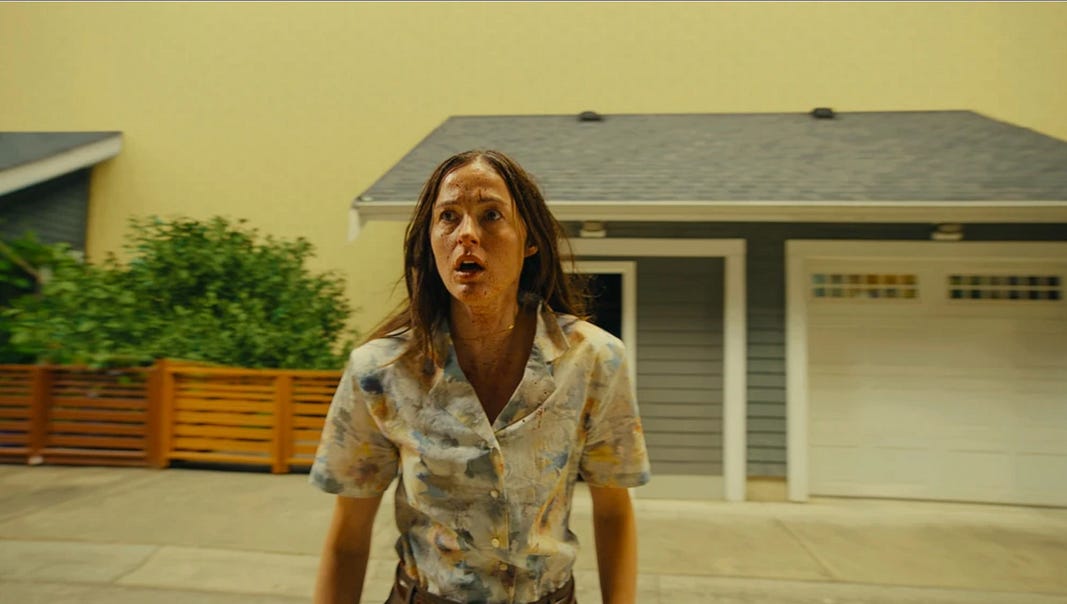
For most of my life as a horror lover, The Shining stood as the gold standard. Ever since my dad first introduced me to the movie as a kid, the very definition of horror has come paired with a mental picture of the infamous mountaintop hotel that frames the movie. It’s the rare horror film that’s disturbing enough to cause nightmares, yet, like a siren song, still regularly beckon me to revisit. For all of its creepiness, the Overlook Hotel has always held a strangely alluring quality. Being haunted doesn’t completely remove its warmth.
There have been times when I’ve watched The Shining through to its closing credits just to immediately start the movie over again from scratch. You’d think it’s weird for the horror genre to ever elicit such a reaction. (Admittedly, it probably is a little odd.) But even among all-time genre greats, few films are capable of balancing terror with intrigue so beautifully.
As time has gone on, I’ve grown to realize that it isn’t the characters that define The Shining for me. Nor is it the plot or writing that makes the movie. Something I think that most people miss when discussing its place on the all-time great list is the magnetism that the hotel holds for so many viewers. At the same time that it’s inherently creepy, there’s also a seductive, last-man-on-earth attraction to the idea of three characters sharing that colossal resort all to themselves.
Every room is unoccupied (sparing a few loose spirits). And if the protagonists want to, they can take up residence in a different room each night, walk to the kitchen in bathrobes, or navigate its cavernous halls via bicycle. It’s both terrifying and mesmerizing in its barren enormity, simultaneously pulling from both nightmares and dreams.
Each time I rewatch The Shining, it taps into the kid in me that used to fashion forts from blankets and chairs, inflating my makeshift home into what felt like entire palaces with corridors between rooms. Those scenes shot from a child’s perspective poignantly capture what it is to be small in a sprawling world.
The snowed-in Overlook Hotel feels removed from time, worries, and obligations. When the movie ends, there’s this feeling of near-envy that I have toward Jack in his ability to remain there forever. It’s an odd sensation, and much of what makes the movie so appealing is that it’s able to activate that part of me that feels drawn to something that, by all appearances, shouldn’t be desirable. It’s chilling largely because I relate to Jack, not in his marital troubles or his madness, but in succumbing to the desolate hotel’s seduction. There’s something strangely comforting about its timeless halls, and an odd romanticism to the notion of an eternity caught in Jack’s unique limbo, forever insulated from the hectic world we know outside.
In making The Shining, I think Stanley Kubrick tapped into a psychological phenomenon that wasn’t yet widely understood. Though the concept of liminality dates back to the early 20th century, the role that “liminal spaces” have begun to play in media today is something few could have anticipated.
According to the Wikipedia page for the concept, liminal spaces are “empty or abandoned places that appear eerie, forlorn, uncanny, and often surreal.” Hundreds of accounts have cropped up across social media that play into the growing obsession, the most famous of which belongs to Kane Parsons, who made a name for himself with a YouTube series called “The Backrooms.” Released when he was only a teenager, the videos are direct predecessors to the Backrooms movie currently in theaters and are what first caught the attention of the A24 studio that produced it. Now at only 20, he’s the second figure to recently sell out theaters after honing his movie-making craft online.

Viewers couldn’t put their fingers on what exactly made The Shining impactful when it was initially released. But if you find either of the “liminal spaces” depicted below to be evocative, then there’s a chance you see what made the film so darkly enchanting. And more specifically, why so many people right now are suddenly talking about Backrooms.
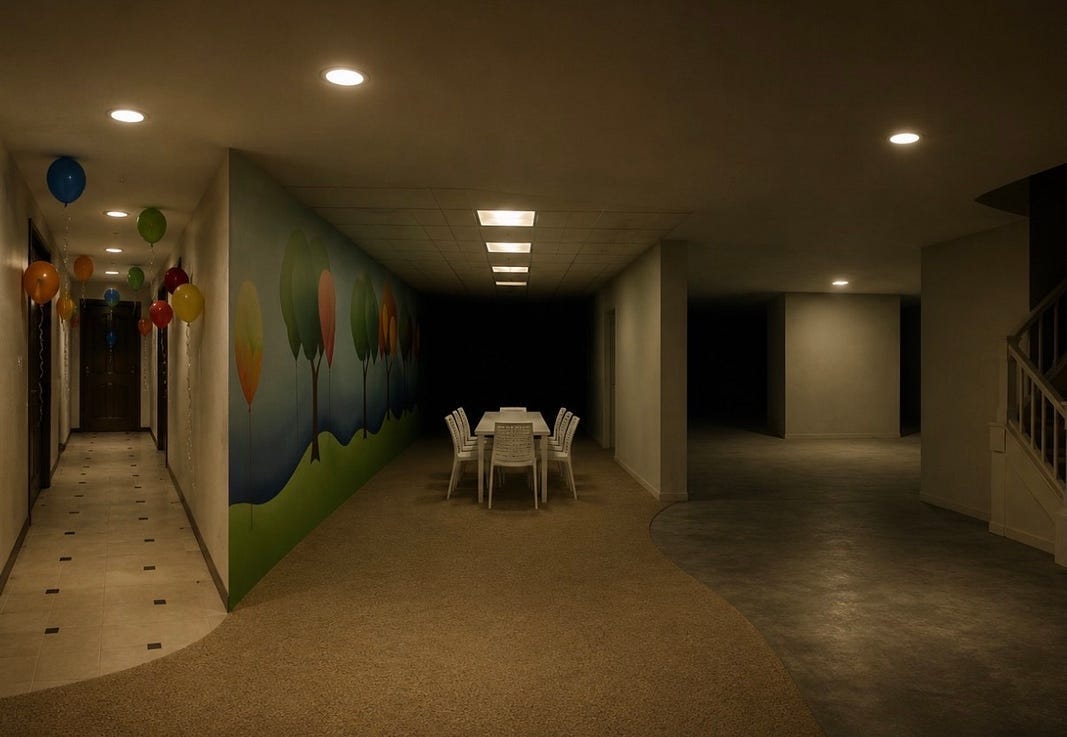
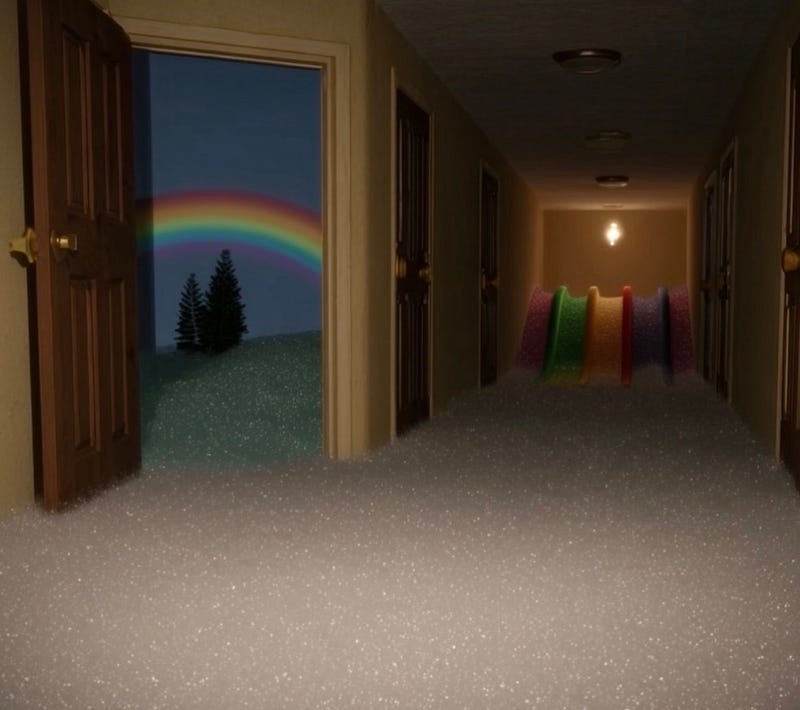
More than The Overlook’s ghosts and evil entities and more than Jack’s descent into insanity, what most distinguishes The Shining is the appeal of inhabiting a place that feels both soothing and profoundly wrong. The liminal spaces depicted above exude enough familiarity that they give the mind something to latch onto and contextualize. But it’s that sense of familiarity that makes the uncanniness feel all the more pronounced. Rather than a totally alien environment, objects are arranged just logically enough to trigger recognition, but just strangely enough to create a visceral sense of wrongness.
In many ways, liminal spaces operate like an uncanny valley for architecture. In the renderings above, we see balloons and colored slides and bright wallpapers that conjure childhood, but in the absence of people, activity, or even windows, there’s an unmistakably off-putting aspect to the imagery. They resemble places that most of us have been or seen portrayed, yet each is stripped of the details that would anchor them to any specific experience. Backrooms takes place almost entirely within this strange terrain.
Another aspect of Backrooms that’s so resonant for viewers is its allegory to artificial intelligence. The source of the film’s horror and attraction is essentially a building misremembering reality, growing more and more inhuman as it stretches endlessly onward. Much like the images generated by AI, the rooms in Backrooms feel assembled by something that grasps the loose outline of the world without truly understanding its rules, physics, or culture. Or as the protagonist tries to explain to his therapist, “It’s like describing a dog to someone who’s never seen a dog, and then asking them to draw it. They might get some things right, but there’s no way they’d get everything right.”
In the same way that AI-generated pictures and videos often have a disconcerting quality to them, it’s the likeness to the world we know that haunts more than something totally foreign would. At the same time that the artificial output unnerves audiences, they’re also perplexingly drawn to it. In the same way that people are leery of AI, yet grow more attached to it with each passing day, viewers are unsettled by Parsons’ distorted labyrinth, yet strangely lulled by it.
Backrooms is one of the first movies since The Shining to effectively couple the terrible with the hypnotic. But more than that hallowed predecessor, Backrooms plays directly into the innate unease and lock-eyed fascination that liminal spaces often induce. There are few films that have transfixed me so fully.
The set design is one of the most nightmarishly bizarre that I’ve ever seen brought to life, but in its nightmarishness, it can’t help but remind viewers at the same time of that most wonderfully loose and boundless quality of dreams. The fantastical rooms and environments depicted are each products of reason in suspension.
Objects are sunken into expansive dingy rugs, stop signs mark the entries to specific halls, doors have multiple knobs and are found on both ceilings and floors. Some passageways are so small that they need to be crawled through, and others can only be accessed by climbing steep, carpeted mounds at the corners of rooms. And through the entire maze are humming fluorescents and monotone yellow walls. The net result is both maddening and bizarrely intoxicating. It’s homey and nostalgic but also twisted and malevolent. It’s dread-inducing, yet strangely pacifying.
Where The Shining takes place in an isolated resort that can’t be accessed by cars through its winter months, Backrooms doesn’t just entomb its protagonists in snow, but thrusts them into a world where nothing is quite right. And as in The Shining, none of the madness seems to matter. The world is indifferent to their plight.
The rooms are sprawling and largely devoid of windows. The windows that can be found only compound the sense of isolation, looking out on walls, other rooms, and model townhomes that are all contained within the expansive, otherworldly complex.
I’m not sure if Backrooms will stand the test of time in quite the same way that The Shining has. The script was a significant shortcoming for the film. But Backrooms’ few flaws are easily forgiven when we remember that Parsons is only twenty. The film’s acting, cinematography, and set design were outstanding enough to cement it as one of the greatest, most memorable horrors I’ve ever seen.
Whatever criticisms can be leveled against him, Parsons has paved a road that future creators will be all but forced to expand on and has proven once again that YouTubers may be some of the most innovative directors of our generation.