
‘The Boys’ Series Finale Is So Bad That it Prompted Fans… To Prompt AI… To Make a Better One
After five seasons, ‘The Boys’ draws to a close. But its finale delivers a familiar sting.

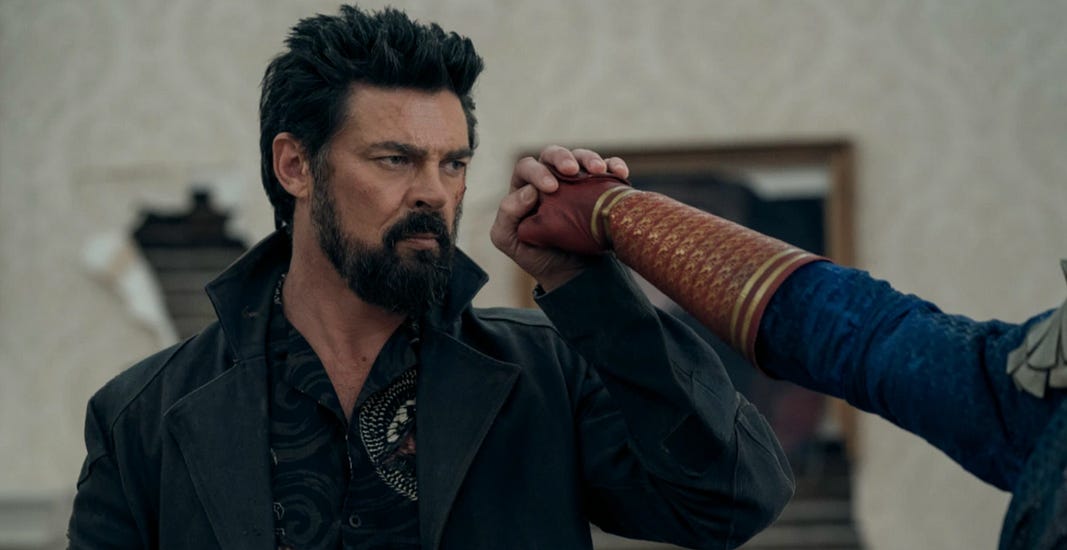
When I read that The Boys’ final act would initially air in theaters before making its way to streaming, I quickly began searching for tickets. But two full weeks out from the final episode’s air date, I was discouraged to learn that its limited screen times were already sold out. With only two theaters in a hundred-mile radius that had agreed to house the finale, and a mere two time windows to choose between at each location, all of the interest that the 5-season show had generated within my tri-state area was seemingly funneled into just 4 packed-theater showings.
Adding travesty to tragedy, the only way to (sort of) watch the finale the night it premiered was to wait until it was available to stream on Prime — at a less-than-ideal 3 AM EST. This not only encouraged some less-than-advisable sleep decisions among loyalists, but ensured that, for those more rationally restrained viewers, their social media feeds would be awash with spoilers from the previous night’s episode. Fortunately, as a lifelong insomniac who can stave off slumber until sunrise when the right article, movie, or video game demands it, staying up into the wee-ish hours of the night to watch a lean 60-minute finale is anything but onerous.
While I may have only discovered the show a modest 14 months prior, putting off bedtime till’ dawn was the very least I could do to repay its generous writers for giving me enough value to stay aboard this subversive train until its final stop. (Or maybe I’ll just make whatever excuses I can find to ensure my rhythms remain as uncircadian as possible.)
But as fate would have it, last Tuesday may have proven one of the rare nights where I would have been better served by a good night’s sleep than staying up until the sound of morning birds contributed backup vocals to my coveted conclusion. The finished product was so abominably tepid that I was both incensed with its producers for building up consumers’ collective hopes, and grateful to all of the glorified Boys aficionados who bought tickets before me and spared me from driving an hour to watch the Titanic sink in person.
Okay, the ending wasn’t that bad. But it was underwhelming enough to plummet to the very lowest IMDB ranking for any episode to date and inspire an army of disillusioned fans to turn to artificial intelligence in hopes it might craft them a better one. I’ll get back to that second part in a bit.
The Boys is a unique creation in the world of superheroes, and its success is what largely guaranteed that its ending would be so poorly received. It arrived into the world as an antidote to the bloated DC and Marvel Cinematic Universes. Immediately, it made a name for itself by depicting superheroes, not as the one-liner trading demigods in tights that so many have grown weary of in recent years, but as undeserving people emboldened by inhuman powers. They’re as flawed, self-serving, and unaccountable as any billionaire— hardly driven by the noble desire to make the world a safer place. And in cynical keeping with reality, governments and corporate entities try their best to politicize the situation, branding bad guys as “super terrorists,” and trying to maximize profits off of their cycling palette of payrolled mascots.
In many regards, The Boys is a satire of the superhero stories that predate it. It was engineered not to simply devolve into a bloated special effects extravaganza as so many other comparable franchises have. And yet, in stretching on for five whole seasons, it ended up succumbing to more than a few of the tired tropes that plagued DC and MCU. With entire seasons of hour-long episodes to fill, there are lamentable character arcs that needed to be devised and significant concessions that had to be made. As the show wore on, it didn’t always feel like the same animal that it started out as.
It became such a central attraction for the Prime streaming platform that it was renewed for season after season. Yet by sheer virtue of its repeated renewals, it started to resemble the shows and movies that it was so busy satirizing. It was an almost inescapable problem in continuing. When one of the primary aspects of its predecessors that The Boys poked fun at was the convolution of other superhero IP, how could it go on — introducing new plots, new characters and new histories— without becoming like them?
To The Boys’ credit, its humorous undercurrent never faded, and the parallels that the show presents to the United States’ political turmoil have buoyed it from season to season. In fact, this recent chapter mirrored our current chaos so completely that its writers seemed to have foresight into certain current events before they came to pass. Creator Eric Kripke even expressed grief over how closely The Boys’ plot portended reality.
But despite The Boys serving as an allegory to our culture since the show first aired, that political undertone of the plot never received any real payoff in the end. It establishes a problem that’s perfectly analogous to our own — a cult-like political movement that’s consumed the American public. But as the snake’s head is removed, we’re left out on the ensuing fallout.
There’s a poignant lesson in that omission, in that none of our own political woes will be solved overnight simply by electing new leaders; the conditions that caused our strife won’t disintegrate overnight. But for fans seeking finality, the failure to even cursorily address the aftermath comes across as a bit of a cop-out. (This aspect of the world will allegedly be explored in a spin-off show helmed by a different creative team, but it would be nice not to be roped into another series just to get answers this final season should likely have delivered.)
While the scope of The Boys is unfair to compare to Game of Thrones, the issues that befell them are more similar than they might appear at face value. Both had too many problems to address within a single, concluding chapter. As a result, the last episodes of each feel like lazy attempts to dispatch the characters left standing and tie off the threads still hanging.
As The Boys burgeoned out into this broader analogy to our political moment, it bit off more than it could chew. And as in Game of Thrones, the way the writers dealt with the single biggest threat in the series was to more or less throw up their hands and just give fans something.
The Boys’ series-long arc that led toward the antagonist attaining god-like strength amounted to a fireworks display that petered out before it even began. Why they decided on a theatrical release for that last episode — and in gut-rattling 4DX of all formats —I can’t begin to fathom. But I’m grateful not to have driven the entire episode’s length just to walk out of theaters with a three-quarters-full bucket of popcorn, mild whiplash, and a welling sense I’d been betrayed.
One of the most interesting aspects of this finale’s reception is that it appears to signal a watershed moment in the relationship between entertainment and AI. In months past, I’d seen this trend beginning to take hold: people prompting AI to depict famous scenes in pop culture playing out differently. Fallen heroes would put up better fights, and antagonists would meet more satisfyingly righteous ends. (We saw another similar use of AI recently, when Iran used it to reimagine a scene President Trump had posted to his social media page depicting himself as Jesus; in Iran’s version, the real Jesus comes down from heaven and casts the falsely halo’d WWIII instigator into a fiery abyss.)
In the past, these AI renderings were often comical in their overt crappiness. But occasionally when I stumbled onto them in my social media feed, I was amused if nothing else.
Yet, unlike only a few months ago, some of the AI-prompted creations made in response to this latest finale — while still checkered by the oddities and artifacts I’m used to in AI-generated content — at their best, are both more captivating and more intellectually intriguing than what the series’ visual effects team produced. They deliver on the seismic showdowns that the promotional material for the final season promised.
Watching the alternate, AI-rendered finales that the fanbase has concocted — or directed computer programs to concoct for them — has also marked a personal turning point for me. I didn’t think it would be so soon that I’d earnestly argue on behalf of a few devotees with Sora memberships over a VFX team with a 100-million-dollar-per-season budget. But if the show had allocated even a tenth of that revenue toward a team of tech-savvy teenagers playing trial and error with video generators, I trust that the completed product would likely have been a more gratifying experience for fans. The show would have been seemingly more equipped to deliver the bombastic ending it spent five whole seasons foreshadowing.
Had The Boys concluded after only a season or two, I think this pared-down conclusion would have felt like an appropriate punchline. But its identity had changed so much since the show’s humble beginnings that it started to call for something different. In creating such an elaborate network of characters and lore, the series’ trajectory shifted and began to point toward a more and more momentous close. The conclusion we got may have worked, but as the head of a different horse.
When The Boys was intent on being a humorous counterpart to more deep-pocketed superhero franchises, anti-climax would have felt like the perfect way to spite them. But as the show continued to balloon in intensity and popularity, it grew increasingly certain that this kind of controlled letdown would never be well-received. Spectators are too far removed from the series’ starting point for this extinguished-fireworks ending to feel like something other than a misstep.
While The Boys finale may not go down in history as one of the worst denouements of all time, it represented a dramatic departure from the lightning-in-a-bottle sensation I felt as I first began the saga. I’m convinced the show just had far greater ambitions than its conclusion was able to meaningfully deliver on.
Ironically, the most fascinating component of The Boys’ ending may not be the finale itself, but what followed it. That disappointed viewers immediately turned to AI to imagine something grander feels like an early glimpse into the future of entertainment. It’s not a future I’m sure I’ll ever fully embrace. But it’s more of an incrimination of humans in this case that I do believe the robots — endowed by the clever prompting of sufficiently frustrated fans — cumulatively generated something more sweeping, fitting, creative, and cinematic than what actually aired.
I heard someone recently make an argument for autonomous vehicles that I was ashamed I never stopped to consider. The rationale for handing over the wheel to a robot isn’t the hope that it would somehow achieve automotive perfection; it’s that human drivers are so radically imperfect that it only requires meeting that low bar for boarding a driverless car to make sense.
The argument for AI in Hollywood isn’t that it’s going to suddenly replace Steven Spielberg or Christopher Nolan. It’s that, in an entertainment landscape increasingly defined by bloat, creative stagnation, and endings that fail to justify their buildup, audiences may grow more comfortable with technology that merely clears the bar continually set by human imperfection.