The Enduring Lessons of ‘It’s a Wonderful Life’
The lesson my teacher imparted that will stick with me forever
In fourth grade, my teacher realized that it was important for our class to see the movie It’s a Wonderful Life in order to properly usher in the holiday season. It was his first year ever educating, and he approached the job with the wide-eyed passion of a man achieving a lifelong dream.
Sometimes that enthusiasm came in the form of lugging his guitar into class and introducing us to the music that had been most formative for his generation. Back in the days when School of Rock was a seismic cultural force, it wasn’t hard to imagine where he found the idea.
But instead of shoving hard rock down the throats of fourth graders, he astutely decided instead that what we needed to soothe our angsty young souls was a little Bob Dylan. (I’ll always be thankful that we grew up in a liberal enough district that no parent objected to these flower-powered departures from our curriculum.)
On other occasions, his excitement for the job came in the form of fervent insistence that we learn indelible life lessons — that we see the movies that matter. But perhaps nowhere could his lovable stringency be more plainly felt than in his die-hard belief that we each see and understand Frank Capra’s It’s a Wonderful Life.
On one momentous afternoon in mid-December, Mr. Cohen left the room and asked that his colleague across the hall briefly monitor us. We watched out the window as snow flurried down from the sky and dissolved away on the hard concrete. I wistfully daydreamed about snowmen and fires and entire weeks off from school. About cartoons, sleds, Santas, and snowballs.
As feathery snowflakes continued to dust the ground, the asphalt black began giving way to subtle shades of storm gray and white. As the blacktop was erased, our class congregated around the window and chattered. There was an uncharacteristic calm that settled across the classroom. We hushedly bantered about the frigid, hot-chocolate-filled season ahead.
Suddenly, a loud sound pierced through the serenity. It squeaked, whined, rumbled, and reverberated off of walls as we looked toward one another with a mixture of confusion, dread, and anticipation. The sound was drawn out to painstaking lengths, but it was a portentous sort of cacophony. Some students could scarcely imagine what was responsible for such a monstrous commotion, but others had learned to associate the grating sound of an approaching CRT TV with enthusiasm. The high-pitch shrill, in times past, presaged day-long stints with substitute teachers, or mornings strapped into The Magic School Bus. We knew it meant that, even if we were stuck watching some sleep-inducing Discovery documentary, we could at least rest easy knowing we wouldn’t be getting another grammar lecture.
But on this fateful day, it foreshadowed something very different.
As a slightly frustrated Mr. Cohen returned to the room, he wheeled the boxy old contraption inches beyond the doorway with a labored grunt before closing the door behind him. We looked toward him expectantly as he internally weighed how to introduce what was coming next.
He carted the TV to the center of the room with brute force, beads of sweat, and a crescendoing series of ugly metallic creaks ricocheting off of windows and walls. Three wheels cooperated in the endeavor, but one appeared to have a mind of its own, completing a series of contrarian revolutions in cackling defiance of his colleagues and the giant puppetmaster wheeling them along.
As the screech reached a close, Mr. Cohen quietly reached the conclusion that the unwieldy cart might be best stored in the classroom closet for however many days it would take to get these jumpy kids to finish a movie.
As the movie began, we were greeted, not to an anticipated whir of colors, but… a monotonous array of blacks, whites, and grays. Mr. Cohen did his damnedest to shield himself from a battery of sighs, objections, and verbal tomatoes hurled his way.
“This movie’s black and white!” a classmate in a graphic tee pointed out as though the peace-loving teacher in slacks had just committed the most heinous of atrocities.
“Is the whole movie like this??” asked another, sure that no entire film could go on so achingly devoid of color.
“Heretic!” chimed in a suspiciously articulate third voice shouted as a crafty trio of miscreants in a corner began extemporizing a scarlet letter to staple onto the harmless, middle-aged man.
Mr. Cohen decided this was a movie best split into chunks. To impose too much black-and-white in one sitting would be borderline soporific for the ADD-addled classroom of SpongeBob SquarePants-connoiseurs. He took to hosting discussions in between sittings to make sure the theatrics of this older style didn’t soar too far above our heads. He was desperate to see the movie take root in the body of restless minds before him.
So the afternoons were interspersed with pauses as the kindly instructor discovered more and more within the movie that demanded proper parental guidance. Social conventions had changed drastically by the time our class full of juveniles sat down to watch the dated old nickelodeon. But they hadn’t shifted quite so far that the movie’s handling of gender issues generated full-blown cancel calls for the untenured teacher. Nonetheless, he was conscientious enough to send students home with a permission slip before we each took part in this heavier viewing experience.
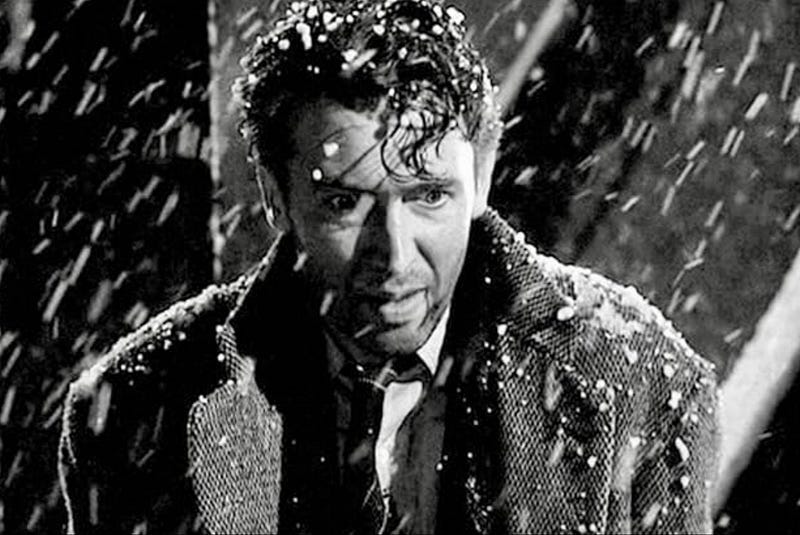
As we made our way further into the monochromatic movie and our tolerance for its dulled palettes began to broaden, yawns transformed into intrigue. By the time the plot kicked into gear and the protagonist, George Bailey, was granted a glimpse into a world without him, a class full of students was suddenly having their first love affair with an all black-and-white movie.
Had we seen the movie in 2nd grade, the subject matter might have been above us, and had we seen it in 6th, we would have gone two years too many without one of the most impactful messages a PG movie has to impart. That no matter what you do, or how awful things seem, or what dead end it appears you’ve reached, there are people in the world who love you.
Suicide is a taboo subject to address for what’s largely lauded as one of the great family-friendly movies of all time. But it’s also one of the very most essential subjects to explore. If there wasn’t another lesson we learned in that classroom, Mr. Cohen would have still offered us something arguably more important than I’ve ever gleaned from another teacher or professor. When I look back over all of the things I’ve learned in school that have simply evaporated, I’ve grown a deeper and deeper appreciation for the educators whose lessons were of the more life-oriented variety.
Though parts of the message about suicide in the film didn’t mean for me then what they do today, I went home happily changed all the same. Now as an adult, with friends who’ve gone down that terrible road, the message of the movie is one that means more to me than it ever used to.
It’s a Wonderful Life was the first film for me to effectively communicate the idea that life is worth living. It’s a powerful portrayal of the fact that each of us leaves an impact on the world. That there are people who would come together and rally in your favor if they knew the stakes. It’s a reminder of all those who would miss you if you were gone.
Ideas like that aren’t easy to impart to children. But life has a way of turning those hokey truisms we dismiss when we’re young into haunting realities. It’s not easy to grapple with such weighty abstracts when we’re still learning our multiplication tables, and one of the great values in cinema is that it helps to elucidate what might feel too colossal or too alien to impart with words alone.
To understand that everyone is loved is one thing, but to visibly see the loved ones gathered around in agony in the aftermath of a loss is another.
And in that house full of people who love the fictional George Bailey, I see the masses of people hurt by suicide, and all those who would have shown up for the lost if they’d only known how much they were needed. I see one of cinema’s most powerful embodiments of the emptiness and despair that suicide leaves in its wake. And I’m reminded of the teacher who felt it was integral that we understood our worth at that early age.


That teacher understood something most adults still miss. You don’t teach kids facts and hope meaning shows up later. You plant meaning early and let life explain it. George Bailey isn’t a moral. He’s a mirror. And the lesson sticks because it’s not loud. It’s just true.
ThankYou for this