
The Game That Shall Not Be Named
… Unless you make it beyond my opening anecdote

“What’s your favorite piece that you wrote in the last year?” Dean asked me as the lingering aromas of devoured holiday dishes wafted through the air of our mutual friend’s less-than-commodious dining room. He had a grin on his face that was equal parts expectant and supportive.
I mused over the question for a few seconds as ambient chatter bounced between windows and walls. The reply that came immediately to mind was a piece from just a couple of weeks earlier. But the answer seemed so uncharacteristic that I hesitated slightly before letting it slip.
Would I be better off continuing to comb through my mental catalogue of work until I landed on something more socially appropriate to share?
Dean and I have had an unusual relationship over the years. Once a bully who made me afraid to go to my most cherished class, there are few people I know who’ve undergone such a radical evolution in the years since high school. Now when we talk, our conversation almost always drifts toward travel and the places we’ve been in the months since we’ve seen each other last. He encourages me to explore the world and I happily reciprocate the nudges.
In his anticipatory gleam, I could see written across his face the answers he was most eager to hear. He thought I’d explain that my solo trip to Costa Rica had made for the most interesting story (it did make for quite a few), or that it was another one of my signature diatribes about technology that took the literary cake.
But when I responded back, “You know, I’m not sure it’s my single favorite piece of the year, but this one I put together about Fortnite actually m — ”
As soon as the name of the game left my mouth, his wide-eyed expectation fled the premises as though I’d stumbled onto TNT or reopened a wound too awful for words. His suddenly stark lack of enthusiasm stole the wind from my sails. “… But this one I put together on Fortnite actually made for one of the most unexpectedly fascinating pieces of the year. It was an intersection between technology, philosophy, and entertainment,” I meekly continued.
Dean tried to courteously feign interest, but it was clear that my in-game escapades didn’t quite rise to the Southeast Asian backpacking trip he was hopeful I might report.
It’s a recurrent theme in covering entertainment that the most rewarding reviews and articles to write are those which touch on deeper societal issues. Still, I’m fairly used to my elders and even fellow peers thumbing their nose at the notion of an essay about the value of Rugrats or SpongeBob SquarePants. Yet even pieces on the most one-note of Marvel movies — or the least sensical of Avatar sequels — pull something surprising from me as they force me to reckon with how special effects have completely transformed the industry and our very relationship with screens.
What made addressing Fortnite especially enthralling wasn’t just how it dissolved my own prior skepticism about the game, but how perfectly it sits in the Venn diagram between cultural excess, the philosophy of technology, and contemporary entertainment. The main image I held of the game prior to playing it was just of some frenetic first-person shooter.
While frenetic Fortnite certainly is, what hadn’t really dawned on me beforehand was how much the game mirrored our present moment. I knew that it was uniquely modern and steeped in our current zeitgeist. I knew that it was youth-coded, meme-shaped, and locked in some kind of incomprehensible feedback loop with the TikTok sphere. But I didn’t quite realize that Fortnite functioned less like a traditional game and more like an intake valve, metabolizing whatever the internet, Hollywood, and pop music spawn in a given month.
I didn’t anticipate the appeal of seeing such a discordant amalgamation of culture all crammed together into a virtual arena: the eponymous K-Pop Demon Hunters dancing in perfect sync as they bide time in the waiting room before battle royales begin. Danny Phantom and Marty McFly trading bullets with Eminem and a mech-suit-donning ensemble of South Park characters. Samuel L. Jackson and John Travolta decked out in faithful Pulp Fiction attire while dueling a laser-beam-gun-equipped Homer Simpson festooned in tighty whities. Batman being heedlessly pursued by a vengeful Sabrina Carpenter as Darth Vader, Goku, and John Wick careen around the tracks of an in-game roller coaster in desperate pursuit of a shield potion or first-aid kit to nurse their battle wounds.
(These scenarios take such an erratically unlimited number of forms — and are so outrageously fun to describe — that I could probably tally them for the remaining duration of this piece. But I’ll spare readers from my incessant listing and simply allow them to continue envisioning mutant crossover configurations at their leisure.)
Fortnite strikes an oddly similar appeal for me as Everything Everywhere All at Once. One of the primary themes that 2022 blockbuster attempts to communicate is that the modern world is so overwhelmingly filled with things and people and stimuli that finding meaning itself becomes a dizzying ordeal. It’s in the frantic collision of disparate elements where the movie is most meaningful. It expresses the insurmountable challenge we face in trying to neatly categorize what we consume and who we are.
Fortnite imparts a similarly vertiginous value, even if not entirely by design. Pandemonium and disordered maximalism override cleanliness and coherence. It’s less concerned with narrative elegance than with capturing continual still frames of an era when everything is, literally, happening all at once. The appeal for me isn’t rooted in any single character, crossover, or mechanic, but in driving home the frenzied sensation of life in our ceaseless, consumerist culture. In illustrating the way that irony, sincerity, nostalgia, spectacle, competition, and chaos all coexist in crushing simultaneity. It’s a miniaturized spin on what we know already — a microcosmic version of the maddening world that we each inhabit.
Fortnite requires vigilance to remain afloat. Breathing through the bedlam. Not getting frustrated when your allegedly friendly neighborhood Spider-Man assassinates you from atop a nearby building, only to saunter toward your unmarked grave and hastily pilfer your belongings.
Another one of the most distinguishing factors of the game is the unprecedented way it leverages technology. As someone who lives in awe of this world where supercomputers sit inside our pockets, perhaps it should have crossed my mind sooner how groundbreaking I’d find Fortnite.
In the past, new video game releases were defined by their cold and mechanical changelessness. The state of a title upon its launch served as a time capsule of the period in which it was designed.
But Fortnite takes advantage of the high speed internet connections that modern gaming consoles provide; now, a virtual experience can be something completely different from month to month and update to update. What initially sucked me in back in November was the introduction of a fully Simpsons-styled Springfield that players could fight in. But once December arrived, I was discouraged to open the game and discover that every semblance of that world had been scrapped overnight and replaced by one modeled after the Western United States. By mid-December, I was equally shocked to turn on the game again and see that the same landscape had been ceremoniously blanketed in snow and interspersed with Christmas-themed items.
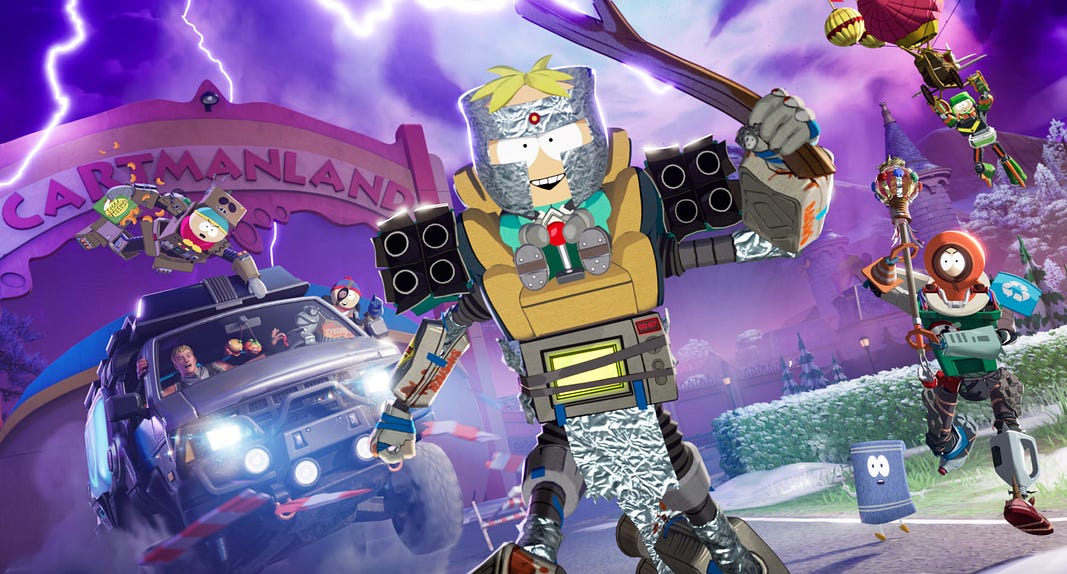
Booting up the game for a half hour on New Years Eve, I was treated to a digital display of fireworks and forced to partake in a brief dance number. (It was a welcome intermission to Fortnite’s customary exchanges of ballistics.) Now that 2026 has arrived, the wholesome Christmas revelry has ended and been replaced by the wise-cracking kids of South Park, as well as a slew of thematically appropriate items from their world.
“Kenny Respawn Tokens” enable us to resurrect after being killed — crashing down from the sky with a box of “Cheesy Poofs” to heal damage and a paltry gun to shoddily fend off against whatever incensed assailants just watched us defy death. “The Stick of Truth” allows whoever attains it to center the match’s mayhem around a designated spot of their choosing. Whether planted in a bathroom, on a boat, or on the game’s most precipitous mountain peak, Xenomorphs and Peter Griffins, Ash Ketchums, Ricks and Morties, Travis Scotts, Ariana Grandes, Leatherfaces, and Kim Kardashians will be forced to manically clamber to its center.
Ironically, if Fortnite weren’t in such constant flux — if it had remained the same digital experience that it was back when it was launched — then I would have never felt pulled to begin playing it. The bias I had against the game stemmed from the complicated building mechanics that were such a crucial part of the experience, and moreover, the competitive extremes that players took them to.
For people unfamiliar with the ecosystem, gameplay quickly started to appear confusing and laborious, if not outright alien. Even as a lifelong gamer, it’s hard for me to make heads or tails of what’s happening in this clip. The convolution created a daunting barrier of entry for players like myself. But with the 2022 unveiling of the “Zero Build” mode, that most intimidating feature could suddenly be scrapped from gameplay completely. And for all those who’d been put off by the complications that building introduced, it had a democratizing effect. It no longer required an apparent degree in engineering in order to participate in Fortnite. People were forced to rely on the natural features of the map rather than taking shelter in an increasingly elaborate series of towering skyscrapers and impenetrable fortresses.
Because Fortnite is 100% free to download and play, developers’ profits come solely from the in-game items and features they offer to gamers. Most notably, they grant the ability to alternate from the default avatars people are saddled with and customize their designated replacement with specific clothing, dance moves, and sidekicks.
For my first few weeks with the game, I’d been understandably resistant to forking over real money for virtual goods. But as time went on, it occurred to me that the proposition involved in such a purchase was hardly different than the one that went into buying any game. Just because I can’t physically set foot in the Mushroom Kingdom and give Mario a high-five doesn’t mean the role that his cartoonish realm has played throughout my life is somehow inauthentic or inconsequential. Just because Hogwarts isn’t real doesn’t mean that Harry Potter is meaningless, or that I should regret buying the books that enlivened J.K. Rowling’s world.
All this is to say, the allure of besting foes while dressed as Bart Simpson won out for me in the end — and a few real world dollars were spent as a slightly shameful result. Call it a moment of weakness, the price of immersion, or call it late capitalism collecting its dues.
As with Grand Theft Auto before it, Fortnite is a game that, for many, has become synonymous with bad grades, digital addictions, and controllers angrily lobbed at TV screens. I won’t dispute that the potential for damage exists. The buoyant, unrealistic nature of the game introduces a levity and frivolity that isn’t seen in Call of Duty titles, but it can also sanitize violence that perhaps shouldn’t be sanitized, or serve as a gateway to darker, grittier material.
By contrast, I’ve always been someone who finds a vicarious thrill in the ability to harmlessly simulate real world scenarios in which I’d never willingly engage. Whether vaulting my avatar fearlessly between mountainous vistas, spurring the local sheriff in Red Dead Redemption II to chase me through town, or scrambling to pick up whatever guns, jetpacks, snowball launchers, and grenades I can locate after being dropped from the sky by Fortnite’s flying bus, the magnetism these games hold for me isn’t that they allow me to play out fantasies. It’s that they offer a controlled encounter with chaos. Peril and excitement are felt, but without any consequence.
Fortnite isn’t my favorite game of all time, but it’s offered one of the first forays into the world of massively multiplayer gaming that I’ve gleaned since my humble beginnings on Club Penguin. And it’s been more fulfilling than I would have ever believed beforehand to be a part of this community that’s so relentlessly present — even if that sometimes demands being ambushed by a game-addled twelve-year-old dressed as Deadpool and gleefully taunted with a Gangnam Style dance.
Yeah. Thats about right.