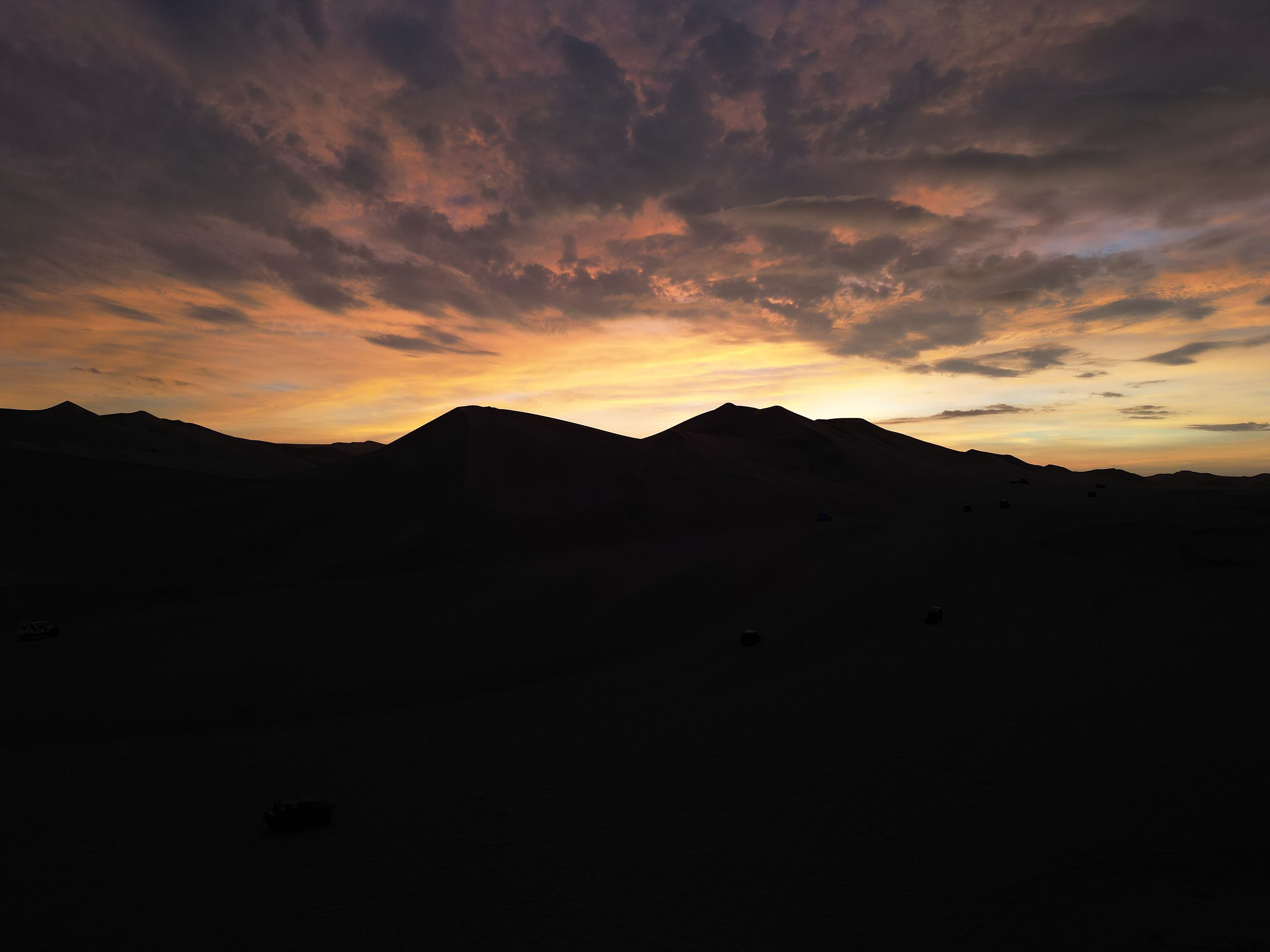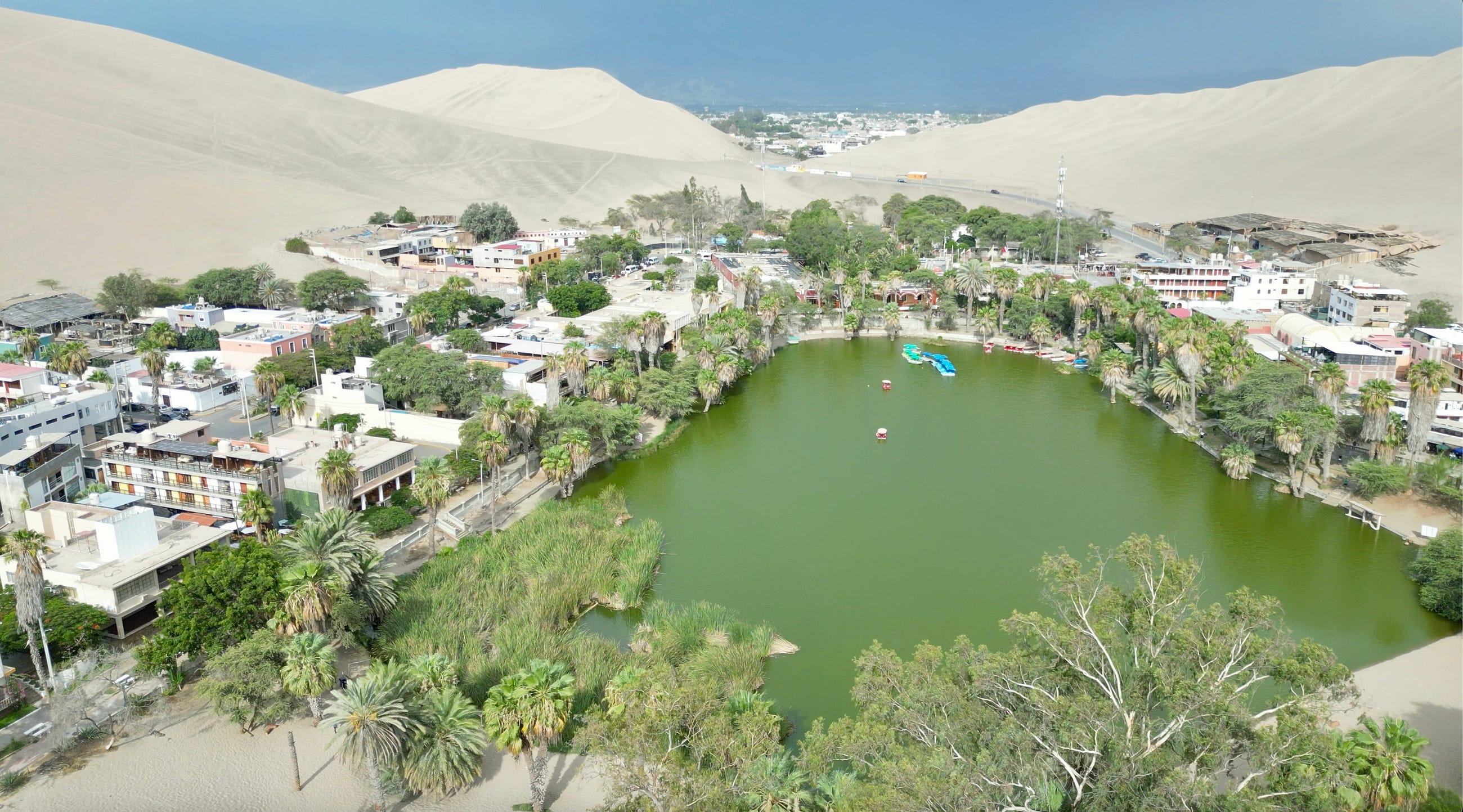
The sun intimately hugged the horizon as my drone hovered in the skies above Huacachina. I watched on my controller screen as I directed the camera lens between dunes and clouds, gliding horizontally across the sky in a tender panorama.
The U-shaped tourist hub consisted of only a couple of streets that orbited an oasis at the town’s gravitational center. Though the scenic waterhole was naturally formed, nearby drilling has threatened its reserves. For the past decade, water has been pumped into Huacachina in order to preserve its aquifer. Though it isn’t wrong when locals and visitors announce the lagoon’s technical status as a “natural oasis,” in truth, each passing year further dilutes its claim to geological purity.
The Eden’s placid waters were periodically criss-crossed by sunscreen-slathered passengers in paddle boats. They were primarily children and seniors, and appeared to be overly prepared for the modest lagoon crossing ahead — each equipped with shades, water bottles, and visors. A few held out selfie sticks as they coasted along the tranquil waters like stereotypes at sea. Meanwhile, the town’s more intrepid guests carved, snaked, skimmed, swept, and slalomed across the giant dunes that flanked the picturesque enclave on all sides. Some stuck to sleds while others tried their luck with skis and snowboards, careening far faster down the sheer slopes than their sluggish sands suggested possible. Others crammed into buggies with strangers or friends and went on rail-free rollercoaster rides over the restless hills.
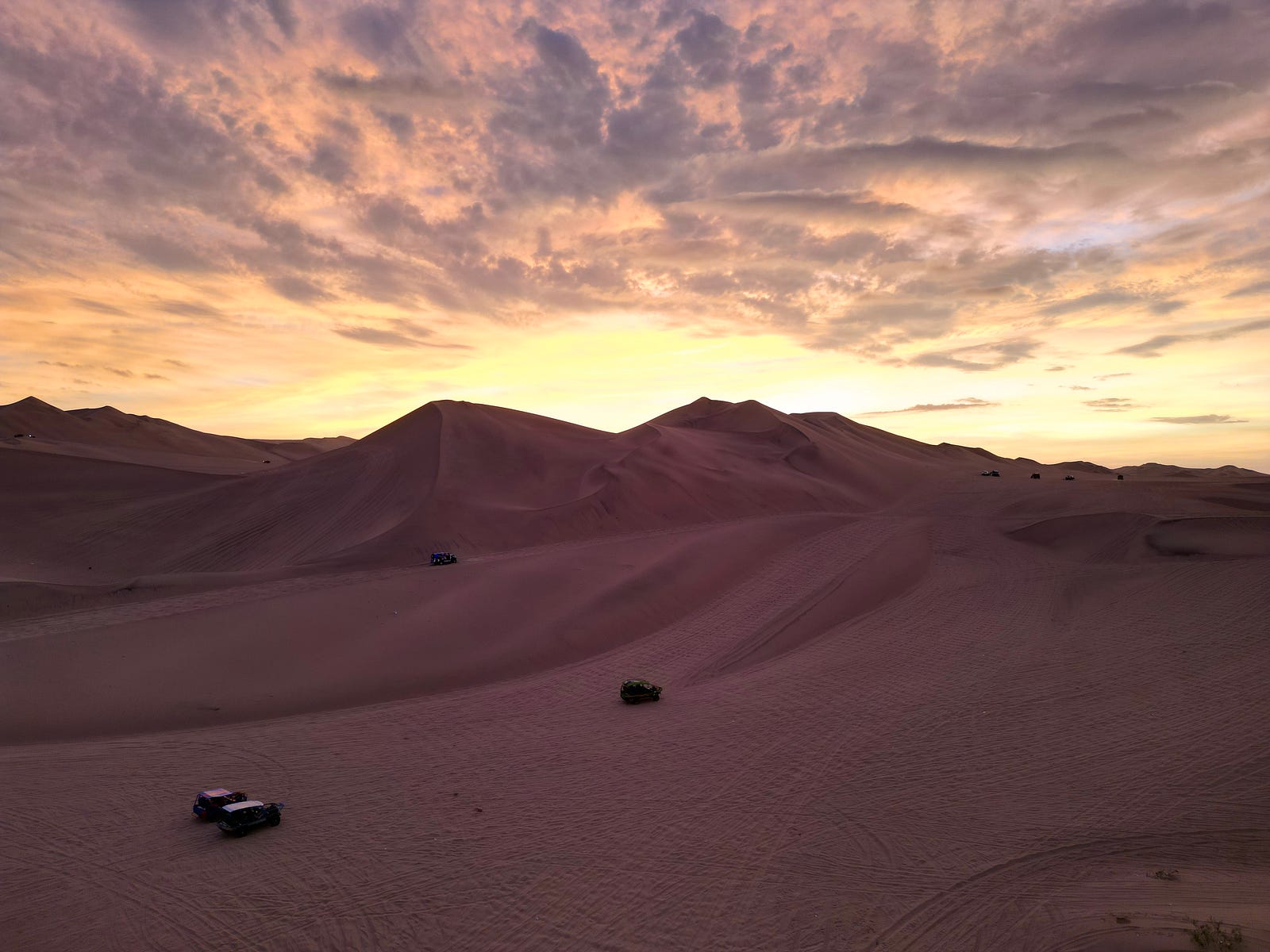
Some rented vehicles, braving the martian landscape on their own as they weaved haphazard trails toward the setting sun. No matter how erratically they drove, nor how precariously close they came to toppling their dune buggies, there was a swan-like grace to the silky patterns they traced.
They etched figure eights like skaters on a frozen pond, and the higher I directed my camera, the more intentional seemed each of the drivers’ micro-movements. The more deliberate became the automotive bedlam. Racy and frenetic gave way to something that looked coordinated. High enough, the patterns carved into the desert appeared like knife scores in butter or elegant brush strokes across a canvas too wide for words. Travelers of a hundred different nationalities teemed through the sun-battered streets in slow-motion as I directed my drone higher and higher into the sky. Even the dime-turning tuk-tuks that darted around the glitzy settlement like dragonflies became fluid as my lens gained height.
The town’s cadence was so consistent — so melodic and multi-faceted — that it seemed more the product of a puppetmaster than simply an accumulation of disordered sightseers and daredevils. How could such a diversity of differently-intentioned people coalesce into something so harmonious?
The rest of the one-horse, twenty-bar town’s temporary transplants were either lying poolside, recovering in beds, downing shots, showering off sand, or completing the trying ascent toward one of the idyllic outpost’s sun-burnished peaks.
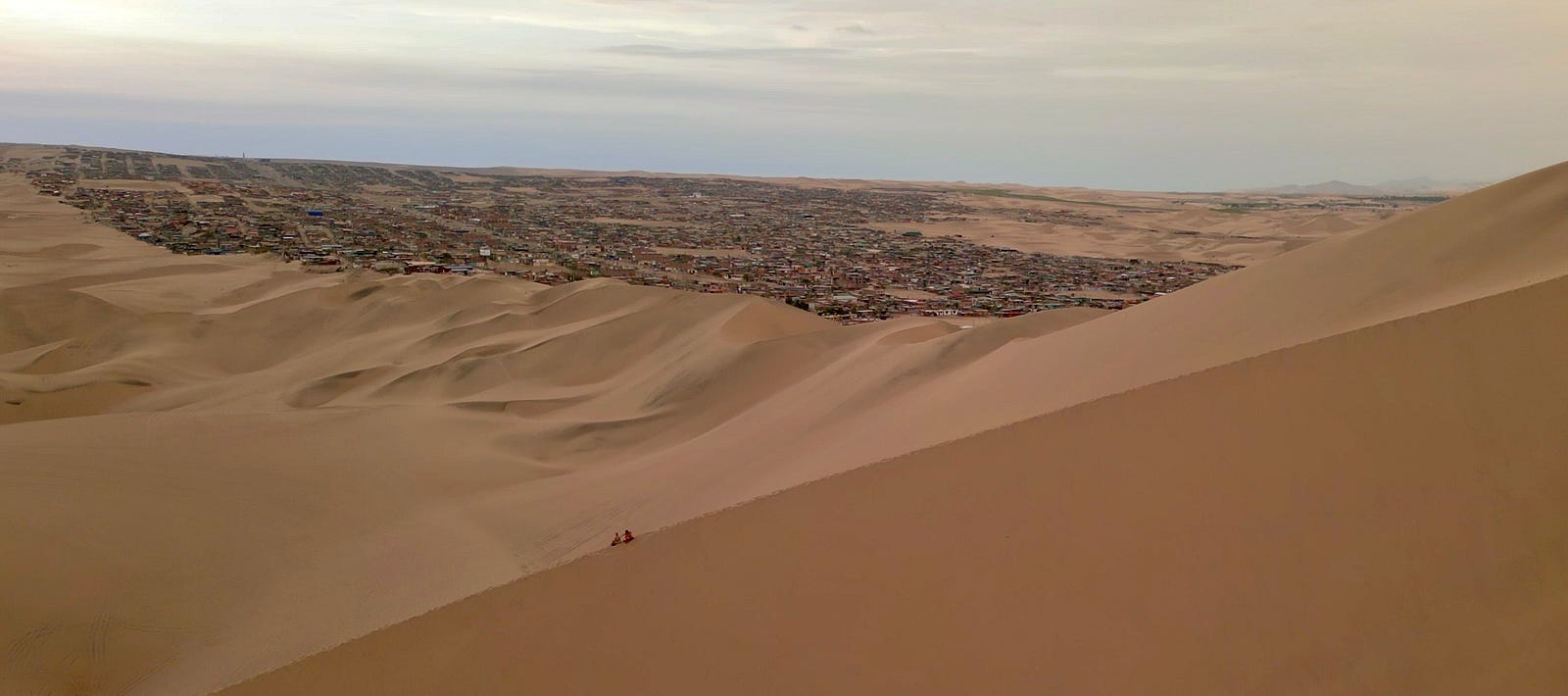
From atop a powder mountain of my own, I guided my flying camera and continued watching the milieu from a bird’s eye view. I swooped through the windless, arid sky over boats, trees, resorts, and the town’s most towering dunes.
With few clouds overhead, a strong reception on my controller, and a line of sight that stretched for miles and miles, I felt emboldened to take my drone further and further. High enough, I could see Huacachina in its true context: a tiny, tourist-facing, leisure-soaked respite beside a sea of urban sprawl that goes by the name of Ica. Next to the patchwork city, my hostel and each of the cafes, bars, and restaurants surrounding it looked more like pieces in a carefully curated diorama — a staged setup beside an impoverished expanse of homes. Only a few massive dunes demarcated the boundary between them.
It was obvious that Ica housed the region’s real culture, but it was the Instagram-ready hideaway that was the draw for the algorithm-driven world around it. As travelers, such tourist magnets can be mixed bags. On one hand, they’re weaker embodiments of the nations that house them than just about any other city, town, or settlement. Yet in the absence of authentic culture, tourist towns like Huacachina are passing reflections of whatever travelers populate them in a given moment. They’re in constant flux, and in their relentless turnover, guests are given more opportunities to interface with more people from more places. Rather than providing immersion in the specific country we’ve traveled to, these liminal towns serve as microcosms of the broader world. With few native dwellers to turn toward, fellow tourists and vagabonds take on the role that locals typically fill.
I perched my drone between cookie-cutter dunes and carefully angled its aperture toward the sunset. I snapped photos as wisps of clouds collaged and pirouetted along the horizon. Patches of plum, indigo, and smoky blue hung lazily in front of ensanguined streaks of orange, amber, and gold.
As soon as the sun set beneath distant folds of sand, the hot, oppressive day came swiftly to an end. A rogue gust of wind swept across the desiccated landscape, a curtain of tiny grains revealing its contours as it insidiously careened. Within seconds, it sent my drone spiraling helplessly toward a divot between an indiscriminate school of dunes. I watched in disbelief on my monitor as the camera above ceaselessly circled, but no matter how feverishly I mashed buttons and fiddled with control sticks to try and regain command, I was powerless to stop its meteoric descent. A wind-carved ridge swallowed the machine as it crash-landed in disconcerting silence.
Half of the device poked free from the desert, its lens partially obscured by sediment. My eyes darted back and forth between the controller monitor and the mute-faced, unblinking desert around me as it descended into dusk. I desperately tried to pull context clues from the sandy sameness as it cruelly mocked my futile efforts.
After ten minutes of searching, a sudden movement on my controller caught my eye. A couple of kids had removed the drone from the sand and begun to curiously inspect the contraption. Their ages seemed to vary between eight and eleven. The device hastily traded hands as the children took turns examining it, some of them miming airplane movements as they sailed and pitched it through the purpling sky, and others a bit more discerning. One of them was so disruptively proactive that he turned off the drone to preserve its remaining battery — thereby severing my connection to its camera and depriving me of my lone clue in this increasingly frantic search. As the sun sank, the ephemeral hills blurred together and succumbed to the elemental night.
I scanned the crowd for signs of the kids, but as people funneled out of the desert and toward their respective dwellings, they congealed into impassable clumps. I let out a few “Has anyone seen my drone?” pleas in both English and Spanish. But as citizens of every nationality rushed past, I was quickly overcome by the sense that I was fighting an ocean with only buckets. Defeat washed over me in crushing waves until my last few appeals were rendered meek and mousy. A cold bead of sweat trickled down my forehead and along my cheek as I trudged up and down the dunes. I made no effort to swat or dry the forming rivulet as the bulbous drop slid its way neckward and began amassing backup.
Each successive shade of blue that cloaked the desert further cemented in the bitter reality that I’d lost my camera — and all of its footage.
Using deep breaths in a fruitless attempt to quell my beating heart, I was unsure whether my hypertension owed more to the fear of all of my lost photos, or the exertion of sauntering directionlessly between dunes. Until I found myself dry-heaving a few meters from a group of bantering buggy drivers, I repressed the signs my body was giving me that I was inching dangerously close to the limits of my stamina and calf strength. Hunched over and looking fully the part of a flustered gringo, one of the workers approached me. “Está bien?” he tried first in Spanish. Seeing I was too encumbered to devise a coherent reply, or too poor a Spanish speaker to make head or tail of his query, he moved on to English.
I sullenly explained my predicament and he nodded along in near complete understanding before returning to his colleagues. What commenced was an exchange that involved 3–4 phone calls, each placed by one of the separate chauffeurs, and a few sparring matches of rapid-fire Spanish that soared so far beyond the bounds of my comprehension that I sat in befuddled silence until a verdict emerged from the chaos. I fought vertigo as my heart returned to a sustainable pace, trying faintly to interpret whatever isolated words slipped free from the impenetrable fog.
Sometimes, it’s more stressful to know a language a little than not at all. When in a room of only Russian or Mandarin speakers, I can rest easy in the knowledge that no amount of listening skills will circumvent my lack of pre-k vocabulary. So long as the situation isn’t too dire, I can turn my brain off and wait for the return of words and speakers I understand.
Yet with languages I know only loosely, I need to actively search for footholds to latch onto and apply far more focus than discourse ordinarily demands. So the passing bits of familiar Spanish that I encounter in conversation that actually compute often create more confusion than clarity. They compel me to search for meaning in strings of ideas that, very often, are just too thick and multi-layered for me to ultimately process.
(Of course, none of this is to say I should stop learning language — only that there are few moments when I’ve felt the harsh sting of assimilation as keenly as I did while marooned beside my backpack, shoddily translating nouns as they whizzed by, and watching the approaching night strip whatever chances I had at recovering some of the most stunning photos I’d ever taken.)
The buggy driver conference continued, but the sparse words I picked up did little to fill me in on whether their prognosis was positive. After a few minutes, I wondered whether they’d determined I was a lost cause and were just waiting to see who drew the short straw and had to tell me. Maybe they’d moved on already to occupational chatter, or some spirited debate about where to get dinner.
“Friend, come with me,” one of them finally spoke up as he signed for me to get into his vehicle. His English was a bit shakier than the previous driver’s, so I tried my best to confirm we were on the same page before complying. But the language barrier proved too immense for a coherent exchange on our battle plan.
When the buggy’s engine kicked into gear, I wasn’t sure whether one of his colleagues had found it, where we were going, or whether it was simply our plan to comb the colossal desert before the final glimmers of sunlight receded. As we began carving violently up the nearest dune, I inched my arm toward the seatbelt with subdued motions. I neither wanted to die nor betray my welling doubt about the nature of this pilgrimage.
It was clear that efficiency was the guiding light behind each of the buggy pilot’s gas-happy maneuvers, and that each towering ridge we surmounted was little more than a trivial speedbump standing between point A and point B. As the ramshackle metropolis of Ica came into frame, it became apparent that he had a specific destination in mind, and that he greeted each sandy precipice we’d cleared as precisely the sorts of waypoints that other drivers search for in buildings and street signs.
The driver stopped on a dirt road in front of a house made largely from plywood and aluminum. Seconds later, out of it sheepishly walked a barefoot ten-year-old with his mother at his side and my drone in his hand. He was wearing a sand-dusted T-shirt and wordlessly handed me the drone with a gentle smile.
As I got back to my hostel and looked at my flying camera in the light, I saw that it had a couple of chipped propellers and one of its four appendages had been fractured. But given the fateful fall from the sky it had completed an hour earlier, it fared surprisingly well. Recovering the device at all seemed unlikely. That I could still turn it on and still get the device’s damaged blades to spin — that all of its footage had survived — seemed like a minor miracle. But more than a miracle, it was a reflection of the kindness of strangers and a reminder that, when traveling, very often it’s the misadventures that make for the most memorable experiences.