
‘The Odyssey’ Breathes Life Into a Story That’s Been Lost on My Generation
Christopher Nolan’s latest film does a great service for the readers who failed to connect with Homer’s epic

If you value my work here and want to help me keep publishing, becoming a paid subscriber would make a real difference. Writing is how I make my living, and it's been an especially difficult stretch lately. Your support helps keep this publication alive. If a paid subscription isn't possible, reposting or sharing this piece with someone who might enjoy it would mean a lot.
Growing up, most of the readers in my school preferred to remain invisible. Our anti-intellectualist attitude was so pervasive that it rendered the admission “I like to read” into a borderline unspeakable taboo.
While every now and then you might find an out-of-the-closet bookworm if you conducted enough interrogations, even high school honors English classes were comprised predominantly of kids who were there to impress or appease their parents. Whenever an unfamiliar stack of books took up residence inside our rooms, we peered suspiciously toward it, hoping and praying that the teetering omen was a concern for another class to shoulder.
When those fateful days finally arrived and the tower of identically-editioned texts toppled into our laps, an unmistakable sense of dread suffused the room. Whether it was Fahrenheit 451, The Great Gatsby, or Macbeth that our teacher was doling out, we squirmed in our seats as we reluctantly scrawled names and dates into our respective copies, our eyes bouncing between windows and walls as we fruitlessly searched for ways to weasel out of each assignment.
Much of our distaste for literature simply owed to the self-perpetuating cycles of coolness that crop up in any school or social hierarchy. But more than that, I think it was due to how much technology had seeped into our lives before we’d ever even heard the name Orwell.
By the time one of us learned that the book had a SparkNotes breakdown available online — or better yet, had been adapted into a movie, the prospect of more than 20% of us actually reading the story at hand was a wash. I’m proud to have fallen within that prestigious minority more often than not. But throughout middle school and high school, I admit that there were a fair number of books that were dull enough that I opted to read summaries or scour out cinematic adaptations instead.
My father read Crime and Punishment alongside me to soften the blow of my daunting summer reading assignment. But by the time we were halfway through, he agreed with my searing appraisal of the writing and granted me express permission to abandon ship just so long as I found a different, dad-approved book to read in its wake.
Brave New World was challenging for a class of ninth graders, but the narrative was adequately engrossing for most of us to at least test its waters even if many of us returned to dry land when we caught first wind of Aldous Huxley’s expansive vocabulary. Romeo and Juliet was onerous, but with a sufficient number of “No fear Shakespeare” translations trading hands between students, most of us could at least grasp the story behind the Pre-Elizabethan English enough to pass our exams.
But I’m not sure any literary obstacle we confronted throughout our high school careers felt quite as insurmountable as The Odyssey (8th century BCE).
From the moment our teacher passed around the books, aged old paperbacks that looked to have been held by Homer himself, it grew clear that the only way we’d endure long enough to reach the conclusion was if we were handcuffed to our desks and drip-fed caffeine. The mere cover on the Robert Fagles edition — a rust-colored ribbon across a jaundiced yellow background — was soporific enough that it made students fight off daydreams and transformed chairs into memory foam mattresses. The wear on the copies seemed to stem more from successive years of bottom-of-backpack neglect rather than anything like affection or fascination. There were no pages turned carefully inward at their corners to mark where readings started and stopped. It bore the kind of wounds that are rarely inflicted on inanimate objects without a prerequisite level of resentment.
Whether split into chunks or procrastinated on until the bitter end, our assigned reading segments never went over smoothly. The hours before tests and discussions were spent commiserating and hastily exchanging retellings. There were fleeting moments when the text managed to pierce our smartphone-addled attention spans. But it just as quickly lost us, setting us adrift at sea with long-winded diatribes of long-lost gods.
Even our teacher deemed some segments so impassably dense that, at one point, she actually instructed us to skip 150 pages. The directive seemed sacrilegious coming from the language-loving pedant, but there wasn’t a lone student among us who was prepared to question the head-turning mandate over the fear it might be rescinded just as abruptly as her silver-platterred offer surfaced. There was a cynical exchange of eyes among the sophomore students as whole chapters flitted effortlessly by in our fingers. But there was comfort in the absolution that came with “just following orders.”
None of us were brave or curious enough to question what the voided material might contain. Our brief stint in Homer’s world hadn’t magically infused us with heroism.
By the end of the book, there were at least a few isolated passages of The Odyssey that I managed to enjoy. Typically they demanded multiple read-throughs in order for me to properly grasp them, but by the time we finished the last chapter, I could at least say I’d caught a few passing glimpses of what makes the story so timeless and revolutionary. I had a hazy understanding of the characters and their relationships, and couldn’t quite see each scene described in my mind’s eye, but I could at least concede that there was something there.
When I heard Christopher Nolan would be adapting The Odyssey, I was excited for one primary reason, and unlike for many, it wasn’t because I had enjoyed the book so much when I was younger. I was excited because it seemed like an opportunity to truly experience the greatness in Homer’s seminal story.
I viewed Nolan as one of the few directors capable of such an ambitious undertaking. Had Roland Emmerich or Kevin Feige been tasked with revivifying the same story, it wouldn’t have excited me a fifth as much. But from the director behind Oppenheimer, Inception, and Interstellar, it was a safe bet that audiences would be treated to something special.
While Nolan has drawn his share of criticism for the omissions that were made in bringing Homer’s epic to the big screen, if one thing was evident from the little time I spent with the source material, it was that it didn’t efficiently lend itself to a cinematic adaptation. While a few directors before Nolan have tried, those finished products have largely suffered from those same elements that made the written form feel so alienating. The language is impenetrable, and the presence of gods is cheesy at best and laughable at worst.
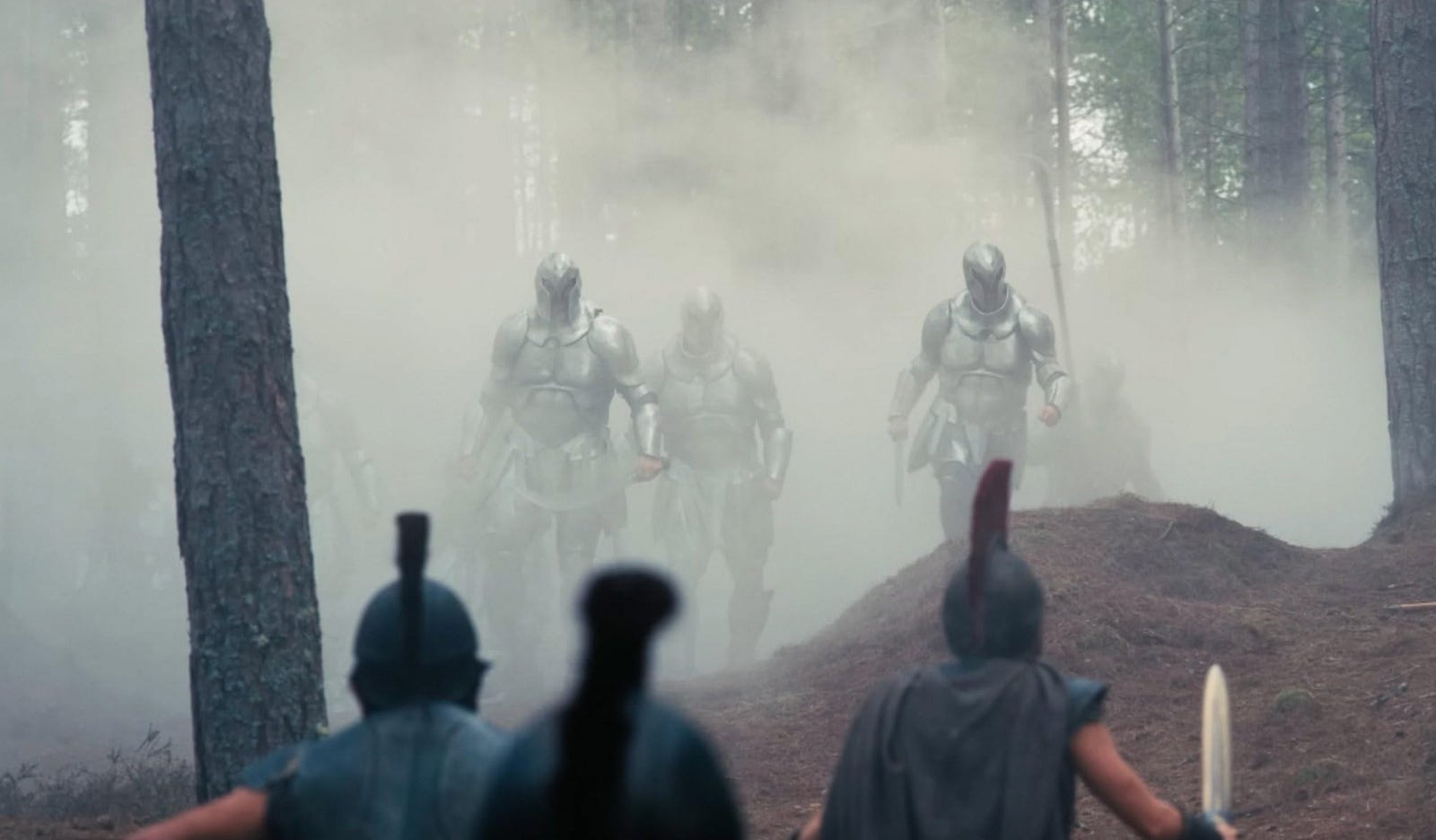
One of Nolan’s greatest achievements in this 2026 adaptation is his ability to imbue a constant air of believability into the mythic. While historians doubt that the famous “Trojan Horse” was a real historical event that occurred, Nolan breathes so much realism into the invasion of Troy that I found myself earnestly wondering whether this was real history being depicted. He portrays the legends with the same level of groundedness that he employs in Dunkirk. And he capitalizes on the tectonic ripple effects that spring from Troy’s sacking in the same way that he does with Oppenheimer and the invention of the atomic bomb.
Not only does Nolan do away with the antiquated depictions of gods, but he introduces so much character to these apocryphal tales that they begin to feel like more than folklore. He preserves the mysticism in Homer’s world with his faithful depiction of giants, witches, and sirens, but does wonders in ensuring that those fantastical elements don’t fester or crumble under the weight of their archaicism.
While I can’t call it a 1:1 substitution for reading The Odyssey, my initial experience with the book was so underwhelming that I actively hoped it wouldn’t be. More than being holistically faithful to the Ancient Greek text, one of the greatest accomplishments that this movie could strive for was to flesh out the story for a new generation. And on that front, I think Nolan succeeds on all counts.