
The ‘Rocky’ Scene That Aged Like No Other
And what the gray areas of cinema have to teach

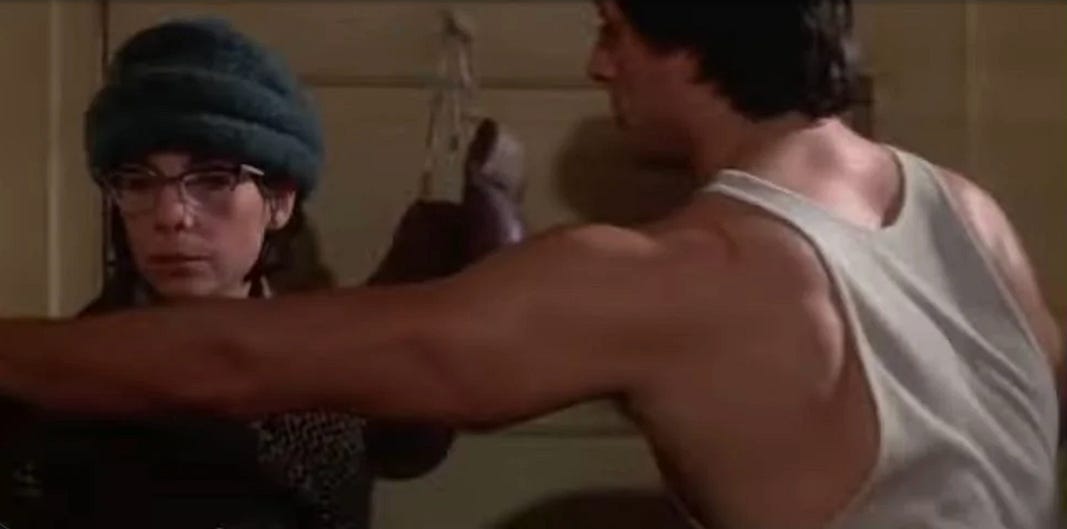
It’s been five whole decades now since Rocky first galvanized a generation. And at fifty years old, few films have held as enduring a spot in the hearts of Americans.
As a lifelong Philadelphian, it shames me to say that I only just watched the movie for the first time last week. As a self-appointed outsider of the professional sports domain, I assumed that Rocky’s appeal depended entirely on viewers’ pre-existing love for boxing.
Even as a modernist who struggles to sit through anything pre-1980, I was impressed at how well the movie holds up. Rocky depicts a city different from the one I’ve known throughout my life. Its culture is different, its atmosphere is charmingly askew, and its skyline is completely unrecognizable. Today, most of the buildings that can be seen during Rocky’s iconic run up the Art Museum steps have been razed and replaced. The once-tallest building in the city has been dwarfed by a new generation of skyscrapers. Where City Hall used to loom over the rough-edged metropolis like a monolith, today it looks quaint.
But the most fascinating distinction between the world then and the world now appears during a scene in which Rocky made a sexual advance on his love interest, Adrian. It’s a scene that’s often overlooked when talking about the film’s continued cultural relevance. In it, Rocky invites his reluctant date into his apartment, and she rejects the offer three times over. Adrian expresses continual discomfort once inside, where Rocky implores her to come closer, “make herself comfortable,” and “relax.”
Once she asks to leave, he blocks the door, inviting her to begin undressing. The five-minute scene offers a masterclass in just about everything that men are taught not to do while navigating the world of dating today. It was evidently written before the conversation about the importance of consent had even began.
One of the interesting components of the scene is that, even in spite of Adrian’s repeated rejections, she’s not portrayed as so unwanting that she appears to mind the kiss or relationship that follows. Yet even still, “no means no” is such an unassailable rule in modern romance that it’s easy for contemporary audiences to see coercion in Rocky’s actions all the same.
“She only complied because she was scared,” it’s easy to argue. “She only agreed to a relationship because she feared he might be violent if she rejected his advances.” He was, after all, a professional fighter.
But even if through the modern social lens Rocky’s actions might be considered tantamount to sexual assault, one controversial aspect of the scene worth examining is that not every situation involving consent is as dualistic as modern discourse suggests. Rocky makes room for that nuance. Of course, back then society was so different that the film’s depiction of romance fell within accepted norms. There wasn’t anything particularly brave or contentious about the director’s handling of the scene.
Rocky is forward maybe, but not to be considered a criminal. He doesn’t respect her continued rejections, and yet, he isn’t portrayed as ignoble. I’ve been surprised by how many female fans of the movie, across generations, are able to cleanly separate Rocky’s behavior from the crime of sexual assault. A couple of women that I spoke with about it were outright dismissive when I made the suggestion. “I mean, yeah, that was inappropriate, but you can still obviously tell that Rocky is a good guy,” they more or less explained.
Ironically, I don’t know a lot of women today who would excuse Rocky’s behavior toward Adrian if they encountered it in person. And yet, in the context of his entire hero’s arc, it’s easy for many viewers to simply deem his actions as a misstep — if even deserving of a footnote.
One of my favorite features of entertainment is the ability to see enough of a character’s backstory and internal world that it humanizes their intentions. In real life, we’re never afforded that opportunity. There’s something that’s inherently enticing for audiences in seeing the kernels of good in antagonists and the shades of evil in heroes.
In Game of Thrones, Jaime Lannister pushes a child out of a window and cripples him before the end of the first episode. And yet, by the time we reach season 3, we know enough of who he is that audiences can’t help but root for him. Similarly with Rocky, though his actions with Adrian are enough to get a celebrity cancelled in this day and age, the movie presents them with enough additional context about his personality that simply assigning him the label “rapist” would feel incomplete at best. He proceeds without Adrian’s consent, but the movie doesn’t portray that transgression as canceling out his caring half, or change the fact that he’s also evidently someone who loves and defends her.
In a way, it’s because the scene feels so jarring to modern viewers that it may actually be one of the movie’s most important.
When cancel culture first began taking hold, I felt a reflexive urge to glom onto the movement. Before the term “woke” became derogatory, I was one of the ones holding up pitchforks and calling for every personality accused of sexual deviance to be deplatformed. I certainly won’t be losing sleep over the Harvey Weinsteins and Bill Cosbys who lost their careers and credibility over their crimes. But it isn’t every Al Franken, Louie CK, or Aziz Ansari who deserved to have their careers tarnished over allegations or details that should have remained in their private lives.
The biggest fallacy in the progressive shift toward cancel culture is the in-built assumption that all of us, apart from the accused, are above reproach. In the calls to cancel public figures over each demerit we find in their personalities or histories is the belief that we all should be remembered by our very worst days or foulest interpretations of our actions. Unless there’s no moment from our past that we’d prefer be stricken from our records, the obsession with celebrity missteps is rarely righteous.
In the days after watching Rocky, a clip of a standup routine appeared on my feed in which the comedian joked that if “you ask a couple in their 90s how they met each other… they will just describe a crime to you.”
The comic then painted the all-too-common-back-then scenario of a man, years older than the woman he was pursuing, asking her out over and over again until she finally said yes. I couldn’t help but laugh because of how true that rang with my own experience talking to the elderly. The societal conventions of their youth now sound like the features of a bygone world. And what was considered normal back when Rocky came out would often be likened to rape today.
I think the conversation about consent we’re having now is important, and that it’s a reflection of societal growth that the scene rang so discordantly for me on that initial viewing. It’s a sign of progress that the protagonist’s actions register as sufficiently off to inspire Reddit board discussions.
But as I reflected more on it, I found myself appreciating how much more the scene has grown to represent in the years since Rocky was initially released.
The scene offers a case study in the idea that intimate scenarios are often too complicated to be reduced to the black-and-white categories that modern standards seem to dictate. Even to most contemporary viewers, Rocky can do what he does without coming across as a textbook rapist or criminal. One of the big takeaways for me there is that, in all of our social progress, there’s also been an element of overcorrection in our treatment of intimate scenarios. We certainly shouldn’t return to the misogynistic attitudes that prevailed when Rocky first came out, but nor should people dating today expect every romantic situation that arises to yield to a clear “do you agree to this sex?” crossroads.
I wish that in today’s social climate, it didn’t feel so controversial to challenge some of the attitudes we’ve adopted. It’s unfortunate that my raising critical objections here will invariably be construed as anti-consent or pro-sexual assault to some readers.
All throughout middle school and high school, my peers and I were implicitly expected to know when and how to make our moves. My first kiss didn’t need to be preceded by an “Is it okay to kiss you right now?” and my first girlfriend certainly didn’t mind. She didn’t feel violated just because I didn’t explicitly ask before acting.
As dating adults, my friends and I have adapted to an ecosystem where we need to be even more careful than we were in middle school. Now that we’re grown up, we’re more mature, more independent, and more capable of recognizing bad situations as they arise. Still, we’re all less trusted to navigate the haziness that romance inevitably breeds.
As a grown man, I ask a woman now if it’s okay for me to proceed in an intimate scenario. And on numerous occasions, I’ve had women tell me after the fact that they would have preferred me to read the room instead of asking so explicitly. Such direct requests can sap the magic from a moment.
And yet, I don’t know how to reconcile that personal experience with the fact that real harm can sometimes be avoided through those simple questions. If we were to return to our old ways, the losses would outweigh the gains. But that doesn’t mean the issue of consent is as binary as it’s often framed in pop culture today. fifty years after its release, that Rocky scene sheds a light on the moral ambiguities that still crop up in dating today and spurs viewers to reflect on how we regard them.
I think that if (usually) the woman felt comfortable saying "no, sorry this isn't what I want right now" without potentially deadly consequences, then just reading the room would be a more realistic option. Men would have to be ok with rejection after making a play - some are I'm sure but we don't know which ones those are.
Well, it's interesting when you have a chance to frame this in a larger context, that being a massive franchise stretching across decades. Because in the scene, he is physically crowding her, conquering her. He wants to subsume her.
And over the course of the movies, that's what he does, throughout a lifetime. She gets sick, becomes a plot device to inspire Rocky in part two. She's barely in three, and by the fourth film, she's lost confidence in her man, not sure if he can win. The movies credibly suggest that, as the doting wife, as Rocky's accessory, she's unhappy. Somehow she dies before him despite the varied headshots he's taken over the years.
So in the moment it's a clumsy seduction, sure. Except that it becomes a blueprint for how the series would treat her. And how many men would treat women, cowing them into taking a backseat role, first in their seduction, then in their domestication, followed by their irrelevance and death. I had a girlfriend too who didn't mind Rocky's come-ons in that scene, so I know the sentiment is common. But part of the allure comes from the seductiveness of the familiar -- the idea that a man would protect a woman as long as she fit within a certain prescribed gender role. Fine for some, not for all.