

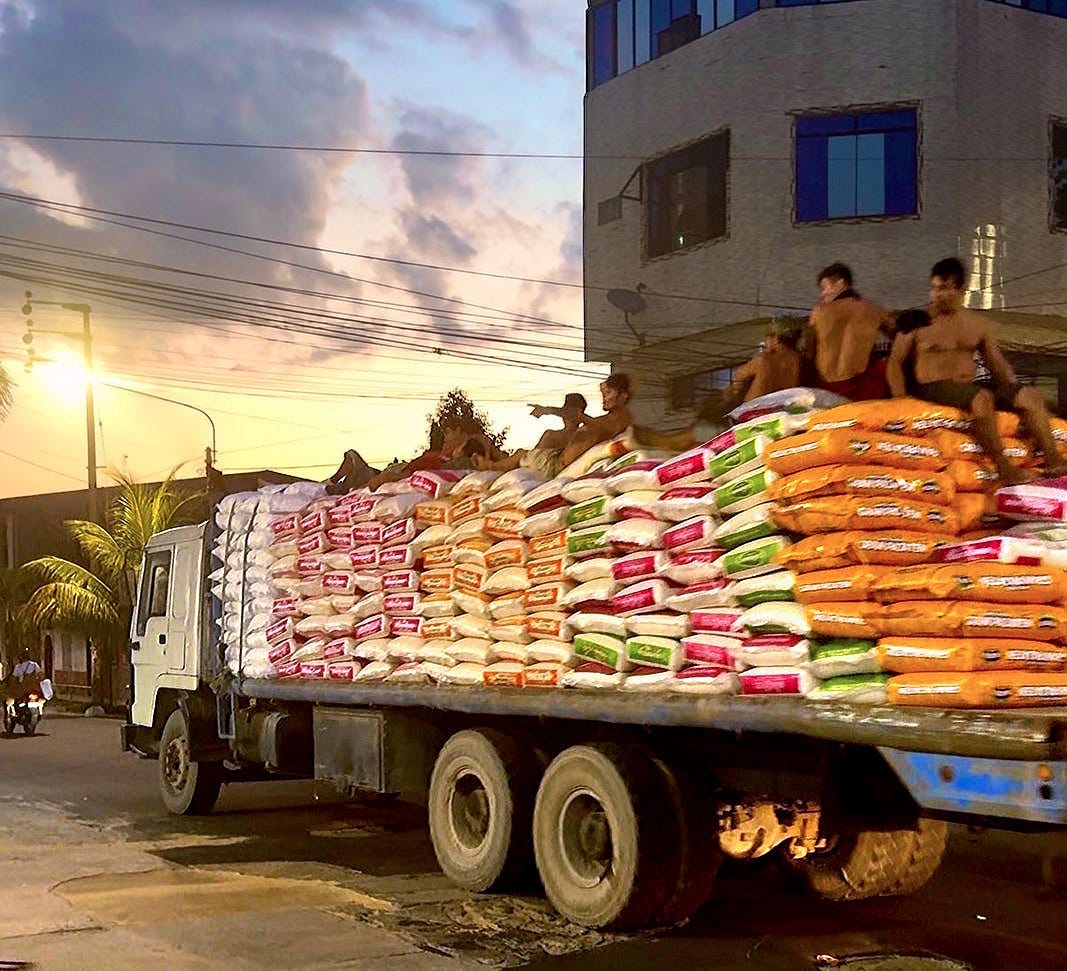
More than ten shirtless men sat atop the semi-truck as it trundled over the craters that pockmarked the streets of Iquitos. Beneath them were sacks of grain, rice, flour, fertilizer, and animal feed that were piled as high as the buckling flatbed would permit. In the most populous city on Earth that can’t be reached by cars or roads, sights like this weren’t so uncommon.
Some of the bare-backed workers watched the evening’s clouds roll by overhead, their gaze as stoic as sentinels. Reflections of street lights and telephone wires swept across the whites of their eyes.
The connective cables were shadeless silhouettes underneath the reddening sky, rising and falling like waves of an ocean or slurred notes on an open-ended staff. They thinned and gathered with no discernible pattern as they snaked between homes, wrapped entire towns in their baby anaconda coils, and circumnavigated the sprawling, isolated city in an operation that was as methodical as it was animalistic.
Wherever there was a break in the powerlines, another series of filaments came into frame and flitted across the tired eyes of the truck’s intrepid passengers. And just as suddenly as the network of wires shuttered out of view, giving way to distant canopies and rust-mottled rooftops, the melody would resume — swelling and receding as the electric symphony’s subsequent movements flared into being. The utility lines skated along the cresting clouds in a way that was at once suave and haphazard, ordered and erratic. Stark black waned and violently waxed while amber, blush, and cerulean blue bled like watercolors through the open sky behind it.
Some of the riders had fashioned mattresses and cushions from the bags of grain, more concerned with getting a few minutes of shut-eye than watching their heat-choked metropolis clunk cloddishly by. Some sat upright, legs swaying back and forth like pendulums in the swampy summer air. Their shiny skin glowed an igneous orange as it refracted the final rays of the setting sun.
Some pointed toward pedestrians like myself, more transfixed by the passersby who were out of their depths in the mosquito-swamped climate than the avant-garde orchestra of moto-taxis weaving frantically in and out of traffic. To them, the outsiders were more striking than the scarcity of seatbelts on their teetering tower of assorted goods-and-grains-repurposed-as-pillows.
As the hulking lorry lumbered down the streets with the earth-rattling immensity of a tank, its passengers were completely unperturbed by silly little things like safety, and its driver was even less perturbed by the looming prospect of a moving violation from the city’s threadbare police force. We were infinitely more out-of-place than the tuk-tuk drivers preparing to careen across the narrow path of the leviathan vessel, the backfiring motorbike to the riders’ immediate right, and the stray dog bolting through the horn-blaring bedlam.
More than the ceaseless drone of insects and more than the entire families crammed onto the backs of rusted e-scooters, for those who’d spent their lives in Iquitos, it was the fumbling gringos like myself who so often stole their attention. More than any of the sights that inspire tourists to take out their phones and snap pictures, it was the tourists who became attractions: temporary transplants struggling to integrate with the restless whole of the sweltering, Amazonian city.
Iquitos fielded its fair share of sightseers, but it didn’t make every Peru visitor’s “must-see” list in the same way as Machu Picchu, so it was often relegated to the sidelines. Unlike in Cusco, where you’re frequently no further than an empanada’s toss from the nearest traveler, interlopers stood out like neon fanny packs in this city carved from rain forest.
Puerto Miguel was a village of roughly a hundred residents and required a two-hour motorboat ride from Iquitos to make landfall on its dolphin-silvered shores. There wasn’t even a golf cart within the jungle-bound villa. A single sidewalk evenly bisected the outpost, and it appeared to have been recently laid.
Half of the enclave’s residents earned income selling groceries or gasoline to the other half. One house provided cellphone service to the entire neighborhood. A building across the street doubled as the patchwork settlement’s court and jail. It was painted in a dull red and green like a Christmas store weathered beyond recognition. Its foundation was stained by the silty streaks of the slowing wet season. As with much of the town, it wore the scars of a building that routinely waged war with the flanking river. Some structures seemed to have been partially swallowed by the annual torrent. A few had been rendered uninhabitable.
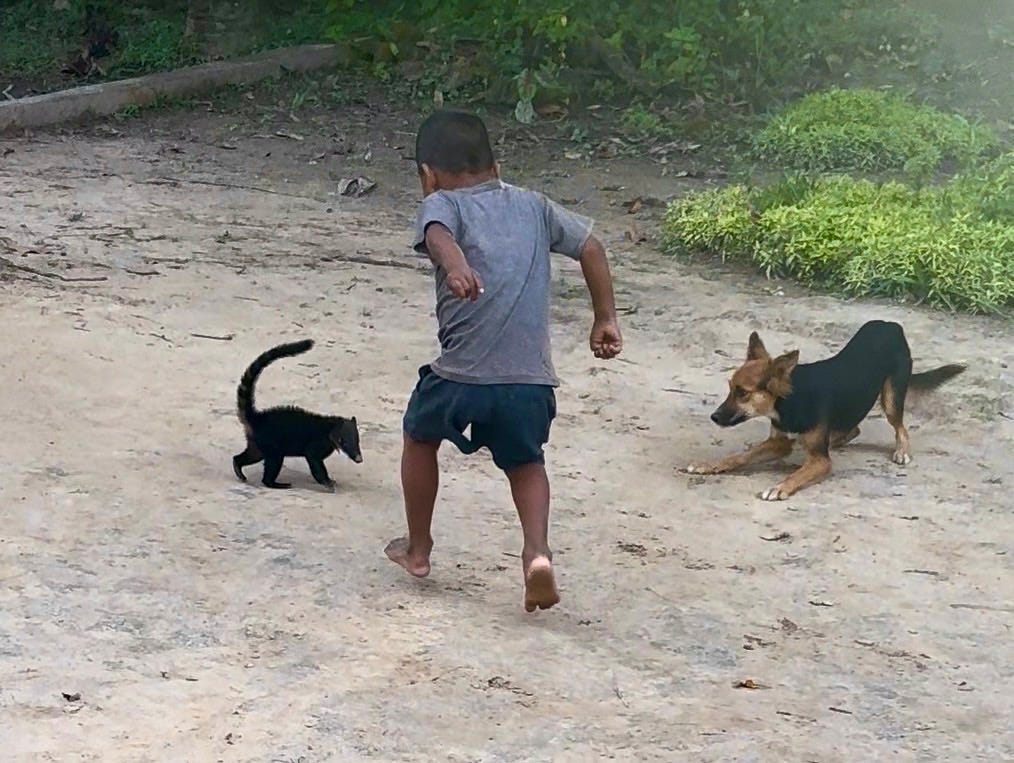
Near the town’s center, a rooster, a toddler, a pair of dogs, and an Amazonian cousin of the anteater engaged in a standoff, each fruitlessly attempting to translate body language across species lines. They stared at one another with rapt attention, advancing and retreating as they skittishly tried to pinpoint where play ended and peril began. The ragtag quintet weaved underneath a home that sat on stilts and onto a sandy court as kids ages 5–15 traded a frayed volleyball back and forth.
None of the competitors paid any mind to the farcical band of misfits distractedly darting between them. Far stranger to them were the visitors who’d landed in their town by motorboat and now ambled tentatively along its single walkway. Some set aside their game completely, gawking and pointing at the tourists like children at a lion exhibit. A couple of them approached us and asked our names in Spanish. One offered us a bracelet he’d spent his afternoon working on.
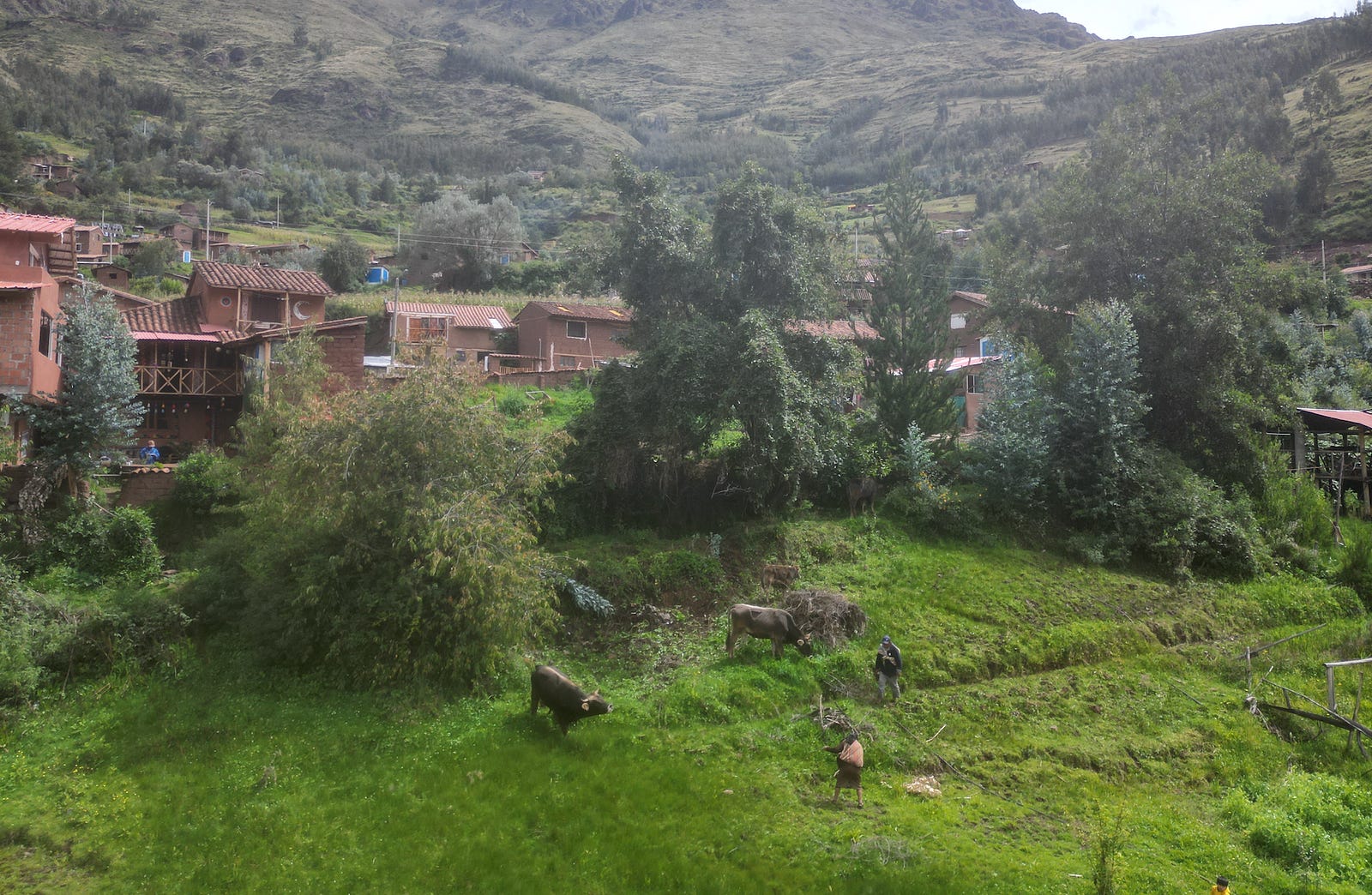
I desperately clenched a makeshift handle screwed into the ceiling of our shuttle as it rattled down the switchbacks that lined the Sacred Valley. Sinking further and further into the crevasse between the seat and sliding door with each stomach-lurching turn, I scanned the other occupants of the vehicle to see how they were faring. There were tradesmen, women preparing to sell crafts, and kids asleep on laps. Mothers looked placidly forward, utterly unfazed by the driver’s breakneck pace around each precipitous bend. Farmers tended to chickens whose aberrant clucks never loosened our gas-happy captain’s grip on the wheel or stole his laser-focused attention from the pothole-latticed byway.
But the most astounding of all to me were the school children who were so accustomed to this commute that the towering vistas outside their windows didn’t even elicit a second glance. They were numb to these daily rollercoasters. And they were so confident in their cowboy chauffeurs that they didn’t stop to question whether they’d arrive at their point Bs on time and in one piece. For them, these rides were every bit as quotidian as my daily routines used to feel for me. The only difference was that the normal I knew growing up was waking up each day, eating toaster waffles as I watched cartoons, and boarding a yellow school bus less than a block from my home.
All through elementary school, I felt as though my little suburbia more or less represented the human condition, and that a magnifying glass pointed toward much of the planet would reveal the same. The circumstances I was born into were all I had to frame my concept of normal.
When I watch my life play out in my mind’s eye, it all feels so obvious. The games of cops and robbers and the entire K-12 school system, our recess times and our units of measurement, our taxes, fashion trends, boisterous football matches, pledges of allegiance, and runaway insurance costs. Our hot showers and abused air conditioners. Our stuffed fridges and overflowing grocery stores. How could it have ever been any other way?
My friend and I walked along a trail only 20 minutes from his Pennsylvania home as we fought off ticks, dangling tree limbs, and overgrown brush. Out of the blue and breaking the silence that punctuated our labored breaths, I asked him what it was like to be a twin.
As an only child, people have often pointed the equivalent question toward me. And in my 20+ years of being confronted with the typical, “So — what’s it like to be an only child?” query, I’ve never really figured out a good response.
My friend, a philosophy major, part-time drummer, and full-time twin, ruminated for a minute before giving me a reply. “I get asked that a lot and, honestly, it’s the only life I really know… what’s it like to not be a twin?” he countered, turning the question on me with a genial smile and a breathy laugh as he wiped a bead of sweat off his face. The frank and efficient response may have owed in part to the August heat, but the brilliantly succinct retort immediately struck me.
It’s impossible for me to put myself inside the shoes of someone who has a sibling. The experience of brotherhood or sisterhood is as foreign to me as, for my friend, the notion of life as anything other than a twin. And I could no more easily understand the twin experience than what it is to be an older brother, younger sister, Chinese teamaker, Tibetan Sherpa, or Amazonian tribesman. I can imagine loose outlines for each of the alien paths. But we can never remove the shells that encase our conscious experiences.
That trite metaphor about “a mile in another’s shoes” that I’ve heard repeated since childhood has only grown more meaningful as the years have flown by. It’s one of the most fundamental truths we have to turn toward when we consider how to be to the people who enter our lives: that we can never, truly, understand what it is to be another.
Growing up, I grasped on an intellectual level that poverty was a pervasive problem across the globe. But I hadn’t had any experiences to ground or calcify that understanding. I hadn’t yet boarded an airplane and flown free from the laws and rails that contextualized my life. I hadn’t ever forced myself to assimilate in another part of the world. I hadn’t seen for myself the reality that life happens wherever you build it, and routine follows suit.
Normal is wherever you plant roots. And the less we’ve seen of the world, the less we understand of all the weird forms that “normal” can take. The less we understand how someone might look at the most mundane and unexamined features of our day-to-day lives and see something remarkable, unbelievable, or outright bizarre.
The more places we go, the more opportunities we have to reflect back on our own fundamental oddity. The more we travel, the more vantage points we find to look toward home with a telescope and see how it fits into our wonderfully grand fixture of weirdos masquerading as normal.
It can be a mind-bending task to look objectively at how we spend our time here on earth. But sometimes, if we’re fortunate, the veils of our internal worlds slip. The scaffolding that keeps us safe inside our own subjective experiences collapses around us, and as we look out from the dust, we see the million other forms that our normal might have taken.
We see the arc of our lives — all of the rules we’ve followed, all of the practices we’ve observed, and all of the ways that we show love for the people in our lives — for exactly as arbitrary as they are. In another nation, or in neighboring regions of the ones in which we already live, there might be entirely different cultures, customs, priorities, and principles that prevail. What we accept as standard is just a spin of the cosmic roulette wheel. We can never fully know what it would be to have lived different lives, been born as different people, or developed different understandings of our world than the ones that our specific lives and paths came paired with.
We’re forever confined to one strange at a time.
The only way that writers on this platform are compensated for the time and effort they put into their work are through your generosity. If you enjoyed this memoir, it would mean a lot if you considered offering your support. These travel-related articles are among my favorite to write, and I’d love to publish more of them.
I love your writing, Ben. It's both thoughtful and colorful, buoyed by your keen sense of observation and skill for articulating what you see.