What Is ‘Fortnite’ and Why Does it Matter?
For many parents, the popular video game stands as a symbol of time wasted. Here’s what they don’t get
It wasn’t long after Fortnite first launched in 2017 that I became aware of the game. Following a brief persuasion campaign from a few of my friends, I installed the budding battle royale title onto my PlayStation.
The download was free, so I reasoned I had nothing to lose, even if, like so many games, I never found the opportunity to play it. Where it’s not usually difficult to find the time to watch the movies I want to watch, video games are so immersive, and demand so much active participation from players, that it’s often hard to grant that same level of commitment.
So Fortnite sat in my virtual backlog gathering e-dust for the better part of a decade. As it became more and more a part of our culture, I felt a continual pull to explore the title. Yet as presidential administrations passed and the pandemic came and went, it never managed to top my list of games to explore next.
Each time a friend asked if I’d had the chance to play yet, I had to disappoint them. “I’ve been curious about that one for a while, but nope!” I’d say, my voice tinged with enough enthusiasm to mask that — deep down — I knew I’d probably never find the opportunity. As with Sea of Thieves, I feared that ship had already sailed, and that I’d be more likely to be struck twice by lightning than to find a group of players willing to accept another amateur aboard at this late hour. The hurdle in learning a completely new game and system of controls was already intimidating, but being thrust into an unfamiliar world and immediately pitted against a digital battalion of seasoned players was a more fearsome prospect still.
So I continued to cautiously spectate from the sidelines each time Fortnite forayed into my spheres of interest. By the time that Marvel characters were welcomed into Fortnite’s fray, the early-stage superhero geek in me could hardly conceal his excitement. The ability to wield Thanos’ Infinity Gauntlet — and lay waste to his strangely colorful new locale — was so appetizing that I nearly bit. But I somehow managed to resist each of the lures that the game dangled in front of me over the years.
It wasn’t until this October — when Epic Games announced that Fortnite would be coming to Springfield — that my long held resolve finally cracked.
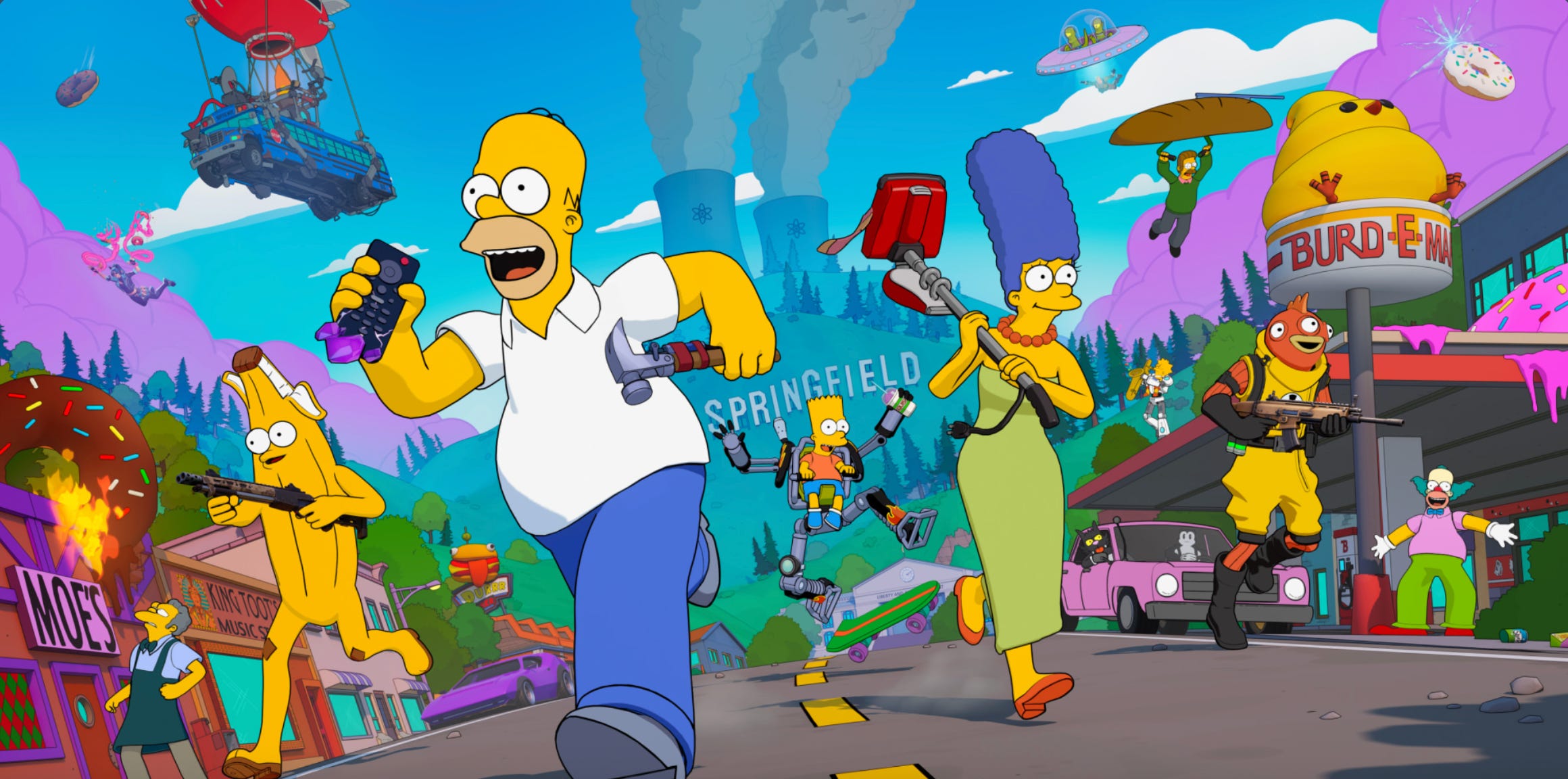
The brash and colorful world of The Simpsons would join forces with the gaming studio’s crown jewel for a month-long virtual crossover event. The calculated assault on my nostalgia was too enticing to resist; it wasn’t long before I found myself officially booting up Fortnite for the first time and impatiently barreling through the profile creation process.
Reviewing The Simpsons x Fortnite experience reminds me of another piece I did for the recently-removed-from-streaming Netflix exclusive, Bandersnatch. It’s conventional to discuss entertainment in the present tense — regardless of whether something was released last week or in the 1800s. But with the title being completely purged from the streaming giant, it seemed to render that convention void. I could no longer talk about what Bandersnatch does, because there was no longer a platform for it to do it on.
It was an interactive experience that demanded viewer input in order to determine the direction that the plot went, and without Netflix’s hosting, Bandersnatch wasn’t something that people could simply buy on blu-ray instead and appreciate that way. So the title is now closeted in a uniquely modern purgatory, and in my review, I felt pigeonholed into referring exclusively to what it was rather than what it is.
Unlike Bandersnatch, The Simpsons x Fortnite event was ephemeral by design. Every last vestige of Springfield was gone from the game without a trace by the time December arrived. So it no longer makes sense to talk about the crossover in the present tense, as people can’t simply download it and experience the same absurdist ecstasy that I did in November.
Taking place in a modestly compacted version of Springfield, participants in the cartoon warzone could eat Krusty Burgers to restore health and have madcap shootouts in The Simpsons’ and Flanders’ houses. They could explore the nuclear power plant, Cletus’ farm, The Kwik-E-Mart, and Downtown Springfield. They could even participate in various missions with Homer, Bart, Marge, and Krusty.
Equipped with copious references and a litany of cars and characters from the show, the brief affair was among the most rewarding experiences I’ve ever had in The Simpsons’ world. The biggest drawback is that it couldn’t last, and that the virtual landscape I came to know in November has been replaced by one with wholly different scenery, items, and rules. (This new map is significantly more realistic than Springfield, and modeled after the United States’ West Coast.)
Yet one of the most distinguishing aspects of the free-for-all-survival contest is just how deeply at odds it is with the world of video games that predates it. Until fairly recently, the condition of a project on launch day was how it would be known forever moving forward. Occasionally there were tweaks made to titles after their releases or as they made their way to new countries that spoke different languages. But the only way for a player to ever see those tweaks or additions that developers made would be by purchasing the game again in its modified form. You couldn’t just connect your console to the internet, download an update, and find yourself with a completely new digital experience on your hands.
Yet more and more often this past decade, the conditions of new games at launch don’t tell their completed stories. Following years of rampant speculation and build-up around the 2020 release of Cyberpunk 2077, it was unveiled to the public in such a shoddy state that it became one of the most defining scandals of that year in tech. It was so ridden with bugs and glitches that most deemed it outright unplayable. (As one of Cyberpunk’s earliest adopters, I can attest that I only sunk an hour into it before permanently shelving it in frustration.) But despite my resistance to giving it another chance, in the years since that controversial release, its developers smoothed out all of those kinks and even inspired some of the most scathing critics to retract their reviews.
Perhaps the most defining feature of Fortnite is the way it leverages the night and day updates that the internet has enabled. While Cyberpunk 2077 is radically different than it was in its earliest days, there’s likely no game that’s transformed more dramatically since its launch than Fortnite. It changes so frequently that it’s actually arranged into “chapters” and “seasons” that update in tandem with our real world’s changing months and years.
Fortnite isn’t merely a story mode or campaign with predetermined stops along a track, but an arc that’s updated in real time and pulls from real events. Drawing from pop culture, music, memes, and entertainment — and of course, fan feedback — where the game will go next is anyone’s best guess. It’s a world in constant flux, and it’s that cycling unpredictability that keeps Fortnite feeling so fresh and interesting for fans so many years after its initial launch. The shifts are as thrilling as they are disorienting and as impressive as they are disruptive. They’re as sweeping and volatile as they are defining.
Loading into the environment for the first time, I was surrounded by gamers who’d known the ins and outs of Fortnite since day 1. They’d been to in-game events and concerts and had carefully curated strategies about which items to use and when. They had communities and histories and deep understandings of the game’s years-long, scattershot narrative. It was all new to me. Being catapulted into the gameplay loop for the first time — or dropped from a flying school bus, as the case may be — I felt like a character joining a show for its fifteenth season or an understudy shoved on stage midway through a play’s final act.
The learning curve was substantial. But I’m a big enough The Simpsons fan to brave plutonium-tainted waters and fend off against whatever three-eyed fish are waiting in its murky depths if it means I can lose myself in a fully-realized Springfield and trade blows with whatever battle-axe-wielding behemoth is stalking me from Bart Simpsons’ bedroom.
The novelty of this take on Springfield also helped to level the playing field between experts, novices, and fellow aficionados of the famous yellow family. Whether new or seasoned players, we were all experiencing the cel-shaded scenery for the first time. Fortnite veterans were forced to correct course in keeping with their new environment, and their fumbles granted cover to the few of us freshmen who were having our first go on that frenzied frontier.
Having grown up on The Simpsons: Hit and Run, I think I was always poised to fall in love with Epic Games’ take on Matt Groening’s storied world. Marketed essentially as a Grand Theft Auto for kids, that mid-2000s release predating it would become one of the most defining titles of the generation. Its gameplay was so delightfully hectic — and the story was so lovably steeped in The Simpsons’ lore — that it still serves for most fans as the greatest Simpsons-stamped game ever released. It was cartoonish enough not to imbue gamers with the militaristic blood lust that Call of Duty titles are so infamous for, but just violent enough that it could curb my more capricious impulses and keep me from begging my parents for my first full-fledged GTA game.
In many ways, The Simpsons x Fortnite crossover is the opposite side of that same coin. Where The Simpsons: Hit and Run grants players a fully traversable 3D Springfield to explore and wreak havoc inside of, Fortnite came paired with a version of Springfield that leaned harder into strategy and combat, yet still refused to abandon the off-the-wall whimsy and chaos that made that earlier Simpsons entry feel so charmingly infectious.
While Fortnite fits firmly within the battle royale genre, and the objective is to use the weapons available on the map to eliminate your opponents, the content is handled with such a lack of realism that it’s unlikely to ever leave players truly thirsting for violence. There’s no blood, no gore, and the world is impressively bright and vibrant for a last-player-standing game. There’s nothing dark and gritty about being ambushed by Homer Simpson with a gun that shoots laser beams, or hurriedly scarfing down fast food to ensure we don’t succumb to our wounds. It’s hard to take being eliminated too seriously when it’s a character in a full-body banana costume who’s carrying out the deed — or when it’s one of the illustrious K Pop Demon Hunters who are dancing over our dropped loot.
I think Fortnite’s greatest value isn’t just that it provides a more benign alternative to its more-hauntingly-realistic-with-each-passing-year competitors, but that it actually offers a counterweight against them. Where so many war games are effectively used as Right wing propaganda, Fortnite not only supplies a virtual space that more and more are using to arrange in-game protests and denounce political overreach, but has even been used to simulate ICE raids and prepare people for some of the ugliest scenarios that the years ahead might pose.
It’s easy for parents — and for critics who’ve never touched the game — to dismiss Fortnite as just another time drain or neon-drenched distraction. But stepping into Springfield and watching that decades-old cultural institution collide with a digital realm that reconfigures itself every few weeks, I realized the game isn’t the enemy that it’s so often labeled. It’s a product of our present moment, but also a mirror of it. It’s chaotic, stimulating, and ever-shifting. It’s frenetic, fast-paced, and meme-shaped. And it exists in a world where breakneck innovation is the rule rather than the exception.
Fortnite matters not because it’s another game in an increasingly congested genre, but because it’s one of the few mass-culture spaces that genuinely evolves alongside the world that plays it. Whether movies, TV shows, or books, each title is a time capsule of the eras that birthed them. But there’s likely no game in history that rejects that standard as flagrantly as Fortnite. It’s such a historic breach of formula that, for better and for worse, it altered what games can be. What entertainment can be. What it means for art to reside in a cybersphere that refuses to sit still.
Fortnite helped ignite a conversation about the nature of updates in a media form once defined by its cold and mechanical permanence. And in unstable times, I can’t help but see something radical in its developers’ willingness to stay so relentlessly up to date. To meet the pandemic with in-game concerts, to meet political turmoil with satirical crossovers, global unrest with shared digital escapes, and the paralyzing uncertainty of modern life with perpetual reinvention.


You’re very entertaining at reviewing things