
‘A Knight of the Seven Kingdoms’ Is a Refreshingly Novel Reminder of Why I Love Westeros
And how the ‘Game of Thrones’ world first pulled me in

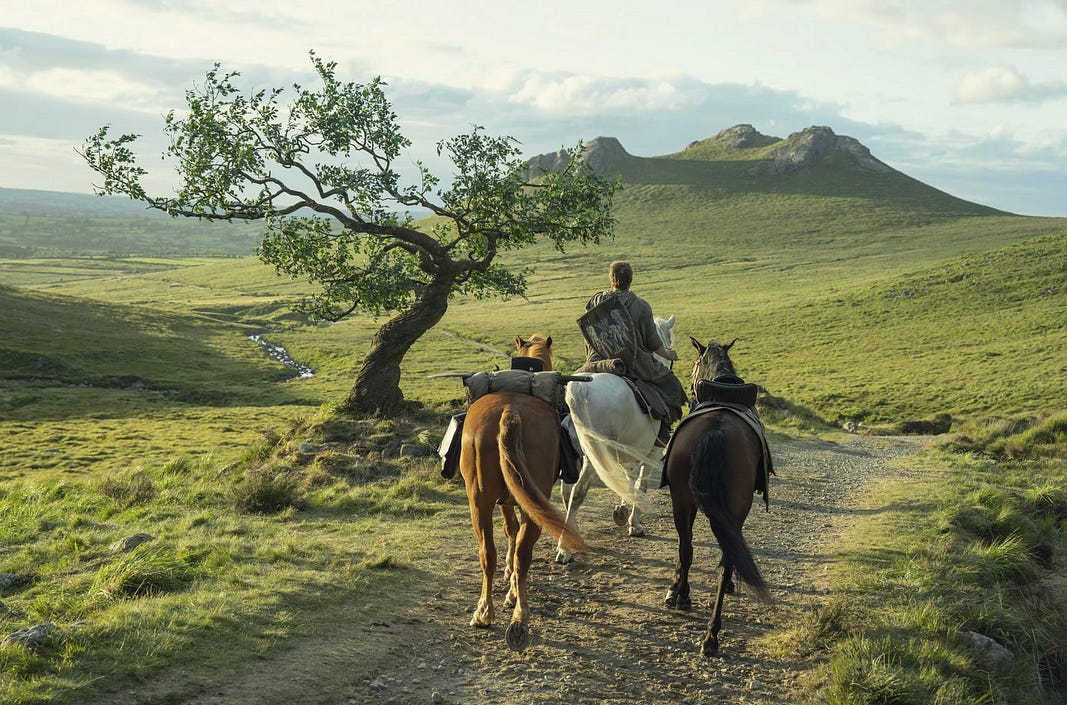
It took years of relentless peer pressure before I surrendered to the cultural juggernaut that was Game of Thrones. My long held resistance owed almost entirely to the subject matter of the show. While I’d seen glimmers of greatness in the Lord of the Rings trilogy, Tolkien’s world never enthralled me in the same way as so many of my friends and elders. There was a certain cheesiness to these fantastical realms comprised of cryptids, monsters, and all sorts of mystical creatures. The movies struck me as campy, self-serious, and, at worst, downright alienating.
So each time someone broached the dragon-helmed zeitgeist I was missing out on with Game of Thrones, I’d simply explain, “I don’t know, I’m just not really into all of that castles, knights, and goblins stuff.” But each Sunday, my peers would punctually queue on couches and consume the fantasy epic with a religious fervor that even the second coming of Christ would solemnly fail to suppress. And each Monday, I’d sit on the sidelines in class as ecstatic recountings commenced.
As the peer pressurings grew in volume, verve, and virulence, I grew increasingly curious about this social phenomenon I was missing out on. When I finally sat down to start Game of Thrones, its sixth season was rapidly drawing to a close.
The show didn’t take for me immediately. The writing was strong, and the universe was intriguing. But all of the characters and their interrelating titles — all of the overarching pageantry and the dense histories of sprawling dynasties — it kept the world under wraps. That walled garden proved hard to penetrate. For the first four episodes, it was mostly the cliffhangers reliably tailing each chapter that roped me into proceeding with the plot.
Yet by the time I finished season 1, there was hardly a thing I could do to resist the primal pull to binge the following five seasons. Engaged in both a desultory exercise in unemployment and an inhuman feat of HBO consumption — I managed to devour a season per day that ensuing week. Once the weekend rolled around, I’d somehow progressed two episodes beyond the friend who had most vigorously implored me to begin the show. As I prepared to watch the fateful season six finale, popcorn in hand and soda at my side, I was devastated to discover it hadn’t yet aired. I’d completely caught up to the present and would need to wait another week for my coveted conclusion.
Once I caught the Game of Thrones bug, I was incurably infected. It was a rare world that seemed to transcend the bounds of fiction entirely. Much of this owed to the brutal stakes that governed it. The characters we loved were susceptible to the same gruesome deaths as the ones we hated.
Arguably the most distinguishing factor of the world, though, is its sheer enormity and lore-soaked depths. Ironically, it was the facet that had initially made the show seem so impenetrable and unappealing for me from afar.
It’s a unique feat that George R.R. Martin achieved in inspiring me, not only to familiarize myself with nearly a hundred different knights, queens, noblemen, and all of their separate motives, but to actually research beyond that. He made me wonder, not simply about the pre-screen history of each of the characters he concocted, but about their forefathers, and how their lasting legacies continued to influence the plot.
Aerys II Targaryen, labeled “The Mad King” after his death, shapes Westeros so much that, even while we never see him on screen for more than a few seconds, he feels like a figure that looms larger than life. Despite being fictional, I wanted to learn his entire story. Looking it up online, his chronicles emerged with the same hardened objectivity in tone that I had assumed was reserved only for historians and their descriptions of Medieval kings. The reverence that denizens of the realm had toward “Aegon the Conquerer,” hundreds of years after his demise, made him feel every bit as real and historic to audiences as the Christopher Columbuses of our own world — all of those figures we learn about in school, yet remain little more than concepts or loose images in our heads.
South Park comically illustrates this feature of the show in one episode by having Mr. Garrison diagram the intricate history of Westeros while his students diligently take notes.
A Knight of The Seven Kingdoms achieves an impressive balancing act in both rewarding the fans who’ve put in the time to understand Westeros and all of its warring houses while also presenting a story that feels self-contained and approachable for outsiders. House of the Dragon, by contrast, is steeped enough in the dynasties and locations of Game of Thrones that it would likely be a daunting entry point for anyone who hadn’t seen that prior show. As in that eight-season epic that preceded it, it quickly inundates audiences with a wide cast of characters and their complicated histories. It demands careful attention, and packs such a copious amount of detail into its hour-long episodes that most will benefit from a rewatch or two.
A Knight of the Seven Kingdoms eschews the pacing and structure seen in both Game of Thrones and House of the Dragon, opting instead for episodes that are a surprisingly digestible sub-40 minutes in length. And instead of leaping between disparate corners of the fantasy universe, it remains largely centered around two characters that are, quite notably, devoid of dragons as a mode of transport.
Less interested in exploring the noble class, the show’s insular focus on common people also helps to humanize the plot and distinguish it from its more pageantry-driven predecessors. The recurrence of familiar house names and introduction of characters we’ve encountered thus far in name alone ensure that it’s a fulfilling watch for Westeros aficionados like myself. But they’re neither secondary enough to feel like fanservice, nor too front-loaded and overstuffed for the show to serve as an accessible on-ramp into the lore.
A Knight of the Seven Kingdoms has caught its share of early flak from fans for the way it’s diverged from the formula that House of the Dragon and Game of Thrones established. But for me, it’s these shifts in approach that make this show’s opening chapter feel so fresh, justified, and promising. Rather than a mere rehash of the tried and true, HBO is creating a unique identity for this third entry in the world of Westeros. I’m thrilled to find out where they take it.
My son told me I had to watch it and I binge watched it, as you did. I am
a dragon fan and that kept me around for The House of Dragons. But I think the current one, which deviates from the royalty and builds through a commoner will be the most fun. And judging from our current government horror
story, a story we need most. I totally agree with you. I'm excited for it.
Thanks for this.
I don't get too involved in canon or details on any of these types of sagas, but I appreciated the very detailed precision of GOT set design. I probably couldn't name many details on any of the houses, even though I watched every season.
This series is quite a step away from GOT, which I enjoyed. It's very different. And very enjoyable. For some reason I was expecting to dislike it. So far, quite the opposite.
The relationship between the two characters is fantastic so far. I hope they don't mess it all up.