‘Akeelah and the Bee’ Is a Tenderhearted Reminder of Why I Love Words
20 years on, Akeelah and the Bee serves as a coming-of-age parable and a wonderfully soulful rendering of the mentor-protegé relationship

There’s something special about the movies I watch on airplanes. Whether it’s the emotional states that come paired with adventures to new places, the stark lack of distractions at our disposal whilst claustrophobically crammed between strangers, or whether it’s merely the change in altitude that alters state of mind, my mid-flight film choices have an unusual tendency to elicit strong reactions.
Associate professor of neuroscience at the University of Nevada, Dustin Hines argues that, “If you look at the human emotional brain and you change anything, especially sleep or oxygen, you’re going to get what’s called a prefrontal disconnect — a disconnect between an emotional area of your brain, the amygdala, and the prefrontal cortex that’s trying to make sense of everything.”
Titled “Feeling Off While Flying? Here’s What Happens to Your Brain and Body at 35,000 Feet,” the article explains that, “this could result in a loss of emotional control — known in psychology as “emotional disinhibition” — and cause someone to cry when they normally wouldn’t.” I won’t deny that I’m overly sentimental. But even if the science isn’t yet there to fully confirm Hines’ theory on in-flight emotionality, I find it unlikely that 50 First Dates would have been enough to provoke glassy eyes for me under less oxygen-deprived conditions.
Whether the same can be said of my experience with Moonlight, Brokeback Mountain, and Frozen— or whether they would have only turned me into a 20% less teary-eyed mess had I been 35,000 feet closer to solid ground— it’s tough to say. But beginning Akeelah and the Bee last week as my plane careened toward Peru, it was hard to predict just how impactful I’d find it. Watching it again, I couldn’t help but see the subconscious stains that it left on that 10-year-old me. That soon-to-be-writer who filed into theaters twenty years prior, both of his word-loving parents transfixed at his side.
Akeelah and the Bee served as a breakout role for Keke Palmer, the actress who would go on to play a lead character in Nope and become a prominent cultural personality. Yet despite her spotlight in recent years, I was surprised to review her filmography and find that, to date, there may not be a single role of hers that was as uniformly well-regarded or endearing for audiences as Akeelah. Set in South Los Angeles, she plays a young girl with a prodigious love for words — an affection that she feels compelled to keep concealed from her peers over fear of ridicule.
Akeelah attends an inner-city school that’s been habitually deprived of funding, and where fellow students treat academic merit as a source of shame rather than pride. There’s a simplicity to the plot’s structure that borders on cliché. Such tropes are hardly new. And yet, they likely wouldn’t be tropes if they weren’t rooted in some painful truths.
Having grown up in a district on the outskirts of Philadelphia, my friends and I saw many of the same disparities that the movie depicts. Often, they presented in an equally stark binary. The honors and AP classes tended to be populated by the children of the upper middle class families, while the remedial ones were marked by an overrepresentation of students from poorer upbringings. We prided ourselves on our overall diversity as a student body, but so often, the way that manifested was in classes that were segregated, not by design, but by circumstance and ingrained generational patterns.
During those few times throughout high school that I signed up for less advanced classes, that culture of anti-intellectualism was all but inescapable. In my grade-level biology course, I was appalled to learn I was seated beside a class of students who thumbed their nose at the idea of evolution. “Are you tryna tell me I came from a monkey!?” I remember one of the students shouting over our feeble-demeanored teacher. She bobbed her head with scientific certainty as the class echoed the detractor’s doubts in crushing unanimity.
As in Akeelah and the Bee, there was a disdain we’d face from others in receiving good grades, and a contrarian pride we’d feel in earning poor ones, as though bleeding red Fs were a barometer of our badassery. But even while this trend of anti-intellectualism was most prominent in the lower level classes, honors English was no exception. Half of my peers would have sooner read the Sparknotes summary for any book we were assigned than going so far as to skim the first chapter.
Each week, when we were given vocabulary lists to memorize, people would scoff and moan at our need to differentiate between the words “bellicose,” “pugnacious,” and “belligerent.” Between “fractious,” “divisive,” “acrimonious,” and “acerbic.” Even in my senior year’s AP literature and composition class, I was the rare student who actively reveled in the subtle distinction between words.
For a while, I’ve wondered why spelling bees have grown to have the import that they do, given that the meanings words carry are infinitely more fascinating and important than their proper spellings — which, not infrequently, vary between regions. But one of my favorite aspects of Akeelah and the Bee is the way that it makes clear that words should never be reduced to raw acts of memorization. It’s our ability to employ them that gives them value.
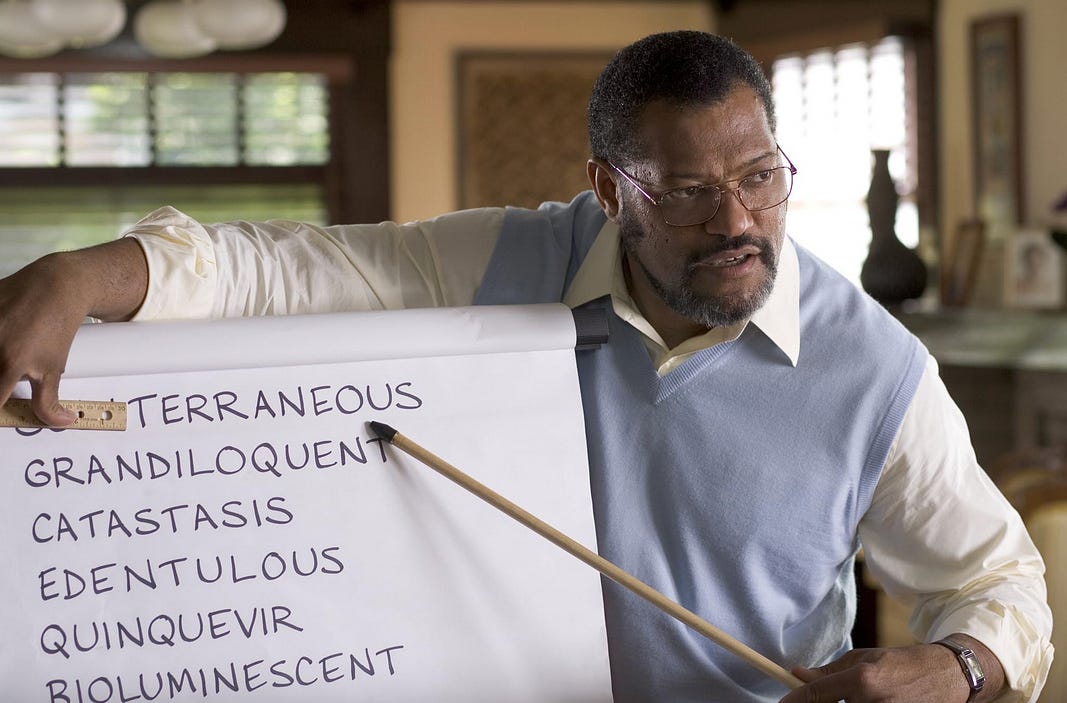
One of the most poignant scenes for me involves Akeelah lamenting to her instructor that the essay she was assigned to read contains mostly words that she already knows. But her teacher, portrayed by Lawrence Fishburne, clarifies that, while her competition might be busy memorizing words like a robot, words have the power to change the world, and that Martin Luther King and W. E. B. Du Bois didn’t “acquire their vocabulary by rote memorization.”
The scene struck at the heart of why I always found those word quizzes our English teachers gave us to be so endlessly enjoyable. They granted an opportunity, not just to memorize information, but to hone our ability to convey thoughts more precisely. Without words, there are thoughts we aren’t even equipped to think, and that foundational fact of life on earth so often seems to get overlooked. It’s in comprehension of their meaning, and of those precise circumstances when specific words are called into action, that infuses our lexicon with purpose. That allows us to communicate with the people we love. The order of lettering says next to nothing about the ideas that words impart, or how wildly and wonderfully those values vary between differing contexts.
There’s a heartwarming sentimentality to the film’s final act that some might find saccharine or overly sanitized. But the uplifting ending serves it well in my eyes. Akeelah and the Bee touches on darker themes without allowing itself to be bogged down by them and the climax feels earned.
Maybe it owed largely to me barreling through the clouds miles above the Atlantic Ocean that this rescreening was so piercing for me. But I think most of its impact owes simply to the homage to language that it so intimately tenders. It offers a tribute to the criminal expanse of words that are relegated to the sidelines in favor of far less interesting ones. And it’s a reminder that words aren’t just for showing off, or some shortcut for passing tests and padding resumés. They’re instruments that fundamentally shape how we think, what we notice, and how we interact with the world around us.


Once again, I must state that you're an outstanding writer, Ben. A great, insightful article. Also, I loved spelling bees as a kid and won second place in my school's 5th grade competition.