
The Future We Know Today
And how the present folds into tomorrow

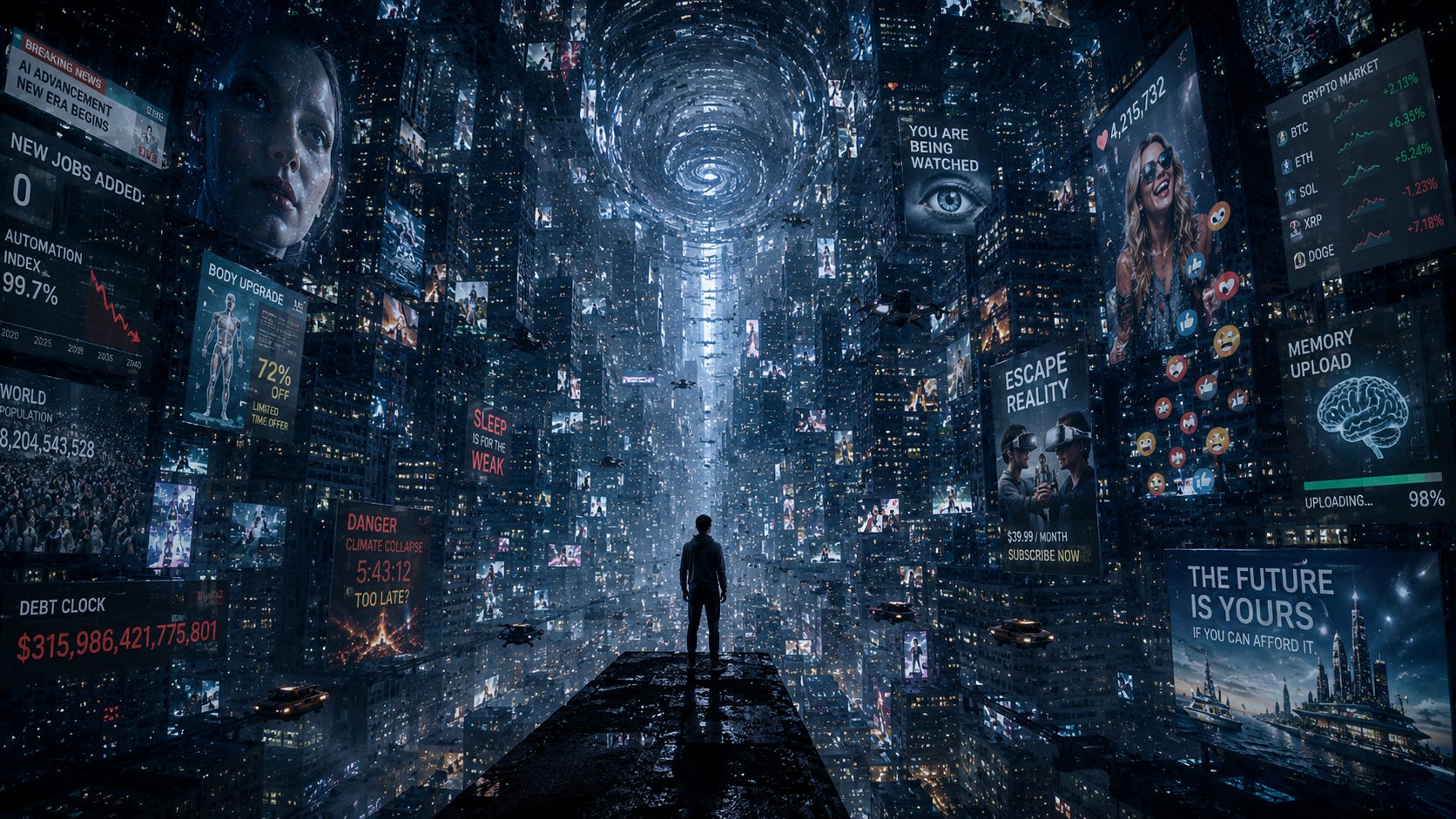
There’s an idea I’ve returned to a few times since I first set out on this writing journey. It’s one of those rare thoughts that not only pushes me to the limits of my language ability, but at moments, feels as though it lies beyond the reach of what words can even impart.
It’s about time, technology, and how the very act of living life — in its wildly varied colors — insulates us from the weight of this bewildering future we belong to. Not the future we’ll greet tomorrow or welcome next year, but the future we know today.
Just as we struggle to wrap our minds around the difference between a billion and a trillion, we have a limited vocabulary for expressing what it is to be alive and conscious as our planet undergoes such seismic shifts. We can describe it in its broadest terms— tally all of the world’s absurdities and catastrophes onto a list — but words fall short of conveying the existential oddity of inhabiting a future that, until very recently, could never have been conceived of.
As children, most of us at least had half-formed notions about what tomorrow would bring. We harbored visions of flying cars and an alien assortment of tools, all designed to make our lives easier and more efficient. But as we tried to construct that once-faraway future in our minds, we couldn’t process it for all of its complexities. We envisioned innovation, but not how it would manifest. We didn’t yet know all of the uses and exploits we’d find for each new tool that entered our lives — nor all of the philosophical dilemmas they would raise.
We live in an era of consequences unintended and Pandora’s boxes pried violently open. There was no predicting all of the colors that would comprise this complicated portrait we call “the present.” At least no more than the inventor of the telegraph could have foreseen his invention burgeoning into an intangible network of memes, texts, and emoji reactions. This inflection point is so kaleidoscopically bizarre that no projection could have accounted for it.
When I was a kid, I expected there might come a day when I’d confer with a computer and have it respond humanly back. Growing up with smartphones, it seemed a safe bet that I’d witness the advent of artificial intelligence in my lifetime.
But what I couldn’t foresee was all of the shapes the innovation would take.
I didn’t foresee grandmothers sharing AI-generated photos of Jesus rescuing flood victims on Facebook, nor teens using artificial intelligence to generate breakup texts, nor the chatbots and the AI-powered detectors designed to catch their misuse. I didn’t expect renderings of historical figures on podcasts, comically fluent in Gen Alpha slang. I didn’t foresee the raccoons on trampolines, nor the deepfake YouTube shorts of politicians. I didn’t foresee having to walk my family through how to tell whether the video they’ve just reshared on social media is AI-generated, nor did I anticipate those giveaway artifacts embedded in each counterfeit growing harder and harder to identify with each passing month.
I could conjure the faintest outlines of this revolution before it arrived, but I couldn’t really prepare myself for the depth of its personality. I saw the loose scaffolding, but couldn’t bring myself to picture all the loved ones living inside.
I couldn’t prepare for the existential weight of this watershed moment — family and friends sitting in rooms and soberly discussing the rise of the planet’s first trillionaires. How we can’t trust anything we see online. How our very sense of shared reality is disintegrating. What it would mean for our most uniquely human traits to be mimicked by a machine.
I didn’t know what it would feel like when my father first asked me, “Ben, can you ChatGPT this for me?”
I didn’t know what it would be to explain to my 96-year-old grandpa that, no matter how much I struggled against it, AI was upending my industry. I watched the sweeping arc of his life flash across his face as it dawned on him that he’d lived long enough to cross bridges he never even knew existed. He was a vestige from another place in time, struggling to keep his walker on solid ground as the Earth accelerated beneath his feet.
I didn’t think that the age of AI would still be feathered by the passing bits of humanity that imbue each second with character and make our time here feel so unmistakably alive.
“… The fact that we are here,
on a floating rock with pollen counts,
paying bills,
missing dead people,
loving living people
who say “leaving now”
while still fully naked and looking for socks...”— Matt Moberg
I couldn’t predict just how much of who we are we’d retain as we braved this new world.
The specter of artificial intelligence has loomed so large for so long that I half-expected we’d be something more by the time we’d construct digital gods to do our bidding. That we’d have crossed new frontiers of morality in order to be a part of this grand new age, transcending all of our ignoble traits and dissolving national borders to fight for common goods.
I didn’t envision our flawed, selfish, idiosyncratic selves facing off against this moment of tectonic uncertainty.
But it’s also that unsavory truth of our circumstances that infuses this epochal crossroads with humanity.
Our conditions are about as dire as some of the most twisted dystopian novels portended. But in greeting each new day beside the loved ones we know — as the meme-trading, binge-watching, tax-avoiding, text-ignoring people we are — the blows of our dizzying world are softened. The strain of staying upright feels less crushing.
It’s the impossible-to-make-up specificity of our ceaselessly weird world that lulls us into complacency. We’re frogs in heating pots. The world looks far too recognizable for 1984 comparisons to ring true. We’re too surrounded by loved ones, too capable of AirDropping fleeting nonsense to friends, and too absorbed in the rhythms of ordinary life to sit with just how dramatically the ground beneath us has shifted.
I couldn’t prepare myself for the numbness I’d feel at this colossal turning point. Sometimes, the emotional gravity of this great reordering subsides and I’m surprised by just how frayed my senses have become. I wouldn’t have thought that blaring alarm bells would so quickly begin to sound like background noise, nor that it would take so little time before something as wildly far beyond my comprehension as AI would begin to feel so banal.
Toying around with the first AI image generator I stumbled onto back in 2022, the transition between “This technology is unbelievable!” and “I wish these images would load a little faster” took only minutes. All of my life, I’ve been assimilating the absurd.
I could have predicted AI playing a larger and larger role in the world. I certainly didn’t envision us coaxing a genie this massive back into its bottle.
When a younger me imagined the future, there was a certain elegance and tidiness to it. I thought we’d veer away from the dystopian fallout that alarmists warned of.
Advancements would arrive, and we’d sort them. Paradigms would shift and we’d always find our footing.
The image I held of the future then was simple. Never fraught. I saw a unified species that found solutions to the problems that ailed it.
I could never have predicted this strange course we’ve taken to get to where we are, nor what this future would look like in all of its dimension once we arrived here. All of the intricacies and oddities that would continue freckling our days once this eerie tomorrow finally thudded at our doors.
One of the heaviest truths of our futuristic present is that our very existence is more consequential than it ever has been. And it’s both humbling and electrifying to mean so much. To be so large before such colossal problems. To be so equipped to take on the greatest challenges that have ever been broached. To leave greater footprints on the earth than all who came before us, and to contend with the possibility we may be the final creatures to leave our mark here. To call this wonderful place home.
We live in the most important time period that has ever occurred. And it’s a privilege to be a small part of this monumental moment. It’s a privilege to be the people standing atop these peaks of innovation, decoding genomes, launching satellites, and looking back in time toward the birth of our very universe. Erecting digital worlds and figuring out laws to govern the Wild Wests we’ve placed into our pockets. Fighting wars as our climate changes and finding ever-inventive and hilarious and loving ways to cope with the great chaotic everything outside our doors.
Asking the grandest questions that have ever been asked as we confront the most massive conundrums that have ever been confronted.
Will we solve the riddle of aging? Will we bridge the gap between brains and computers? Merge with machines? Watch our dreams unfold on TV screens?
End the global starvation crisis as algorithms code cures to our diseases?
Will we ride this parabolic slope upward until we disappear into oblivion? Will we colonize the galaxy in the same way we have our world?
Will the ills that plague us here today all become problems of the past? Distant memories we can reflect on and romanticize?
Can this future still be as bright as we once believed?
No one knows what happens from here, and there’s an enchanting beauty in sharing that uncertainty with 8 billion others. Each of us is forever blinded to what new days will bring, forever our irreducibly odd selves as we confront the future in our front yards.
Such an amazing piece!
As an old man fast approaching his 72nd birthday (it boggles my mind I'm this old!), I'm deeply disheartened by the current sociopolitical state of America, frightened at the prospect of what AI will bring, and glad I don't have too many more years left on this planet.